
The Quarterly News and Our Views
Global Markets: Third Quarter 2026 Review
Looking Beyond the Headlines
The third quarter of 2026 once again demonstrated the resilience of global equity markets. Despite geopolitical tensions, rising oil prices and higher bond yields, equities continued to advance, supported by strong corporate earnings. Bond markets, however, painted a more cautious picture, reflecting concerns about inflation, government debt and interest rates remaining higher for longer. The message for investors is clear: quality companies can continue to do well, but the margin for error is narrowing.
Markets Focus on Fundamentals – But Valuations Matter
Global equities remained resilient, with the MSCI ACWI gaining approximately 2.5% during the quarter. Strong cor-porate earnings were a key driver, with 86% of S&P 500 companies reporting by the end of July exceeding expectations. Encouragingly, analysts continued to revise earnings forecasts upwards, reinforcing confidence in the underlying strength of businesses.
However, much of the market’s momentum remains concentrated in companies benefiting from artificial intelligence and the enormous investment in related infrastructure. While this creates exciting opportunities, it has also pushed valuations higher. The question is no longer whether AI will transform businesses, but whether future returns will justify the expectations already reflected in share prices.
Bond Markets Send a Different Message
While equity investors remained optimistic, bond markets were less comfortable. US 10-year Treasury yields rose by more than 80 basis points during the quarter, reflecting concerns about inflation, government deficits and prolonged higher interest rates. Higher borrowing costs have important implications for governments, businesses and investors. They increase financing costs and place pressure on highly valued assets. Strong earnings have so far helped equities absorb these pressures, but should earnings disappoint while yields remain elevated, markets could become considerably less forgiving.
Credit Markets: Calm on the Surface, Cracks Beneath
Public investment-grade credit markets remained relatively stable, supported by healthy corporate balance sheets. Private credit, however, warrants closer attention. Rising redemption requests in certain funds have highlighted concerns about liquidity, lending standards and heavily indebted borrowers. There is little evidence of widespread financial stress, but prolonged higher interest rates are increasing pressure on weaker businesses. This reinforces the importance of financial strength and prudent risk management.
Currencies, Inflation and Interest Rates
The US dollar strengthened during the quarter, supported by higher bond yields and demand for safe-haven assets. Inflation remains a key uncertainty, particularly with Brent crude ending September above $100 a barrel. Although inflation data showed some encouraging signs, elevated energy prices and resilient economic growth have complicated the outlook for interest rate cuts. Central banks may therefore have less room to re-duce rates than markets previously anticipated.
Company Earnings Remain the Key Driver
Despite these challenges, corporate earnings remain the strongest support for equity markets. Many companies have demonstrated their ability to protect margins, generate cash and adapt to higher costs. This reinforces a central principle of our investment philosophy: over time, investment returns are driven by a company’s ability to grow earnings and cash flows, and to reinvest capital profitably. While economic developments influence short-term market movements, the price paid for a quality business remains critical to achieving attractive long-term returns.
Looking Ahead
As we enter the final quarter of 2026, investors face an unusual combination of strong corporate fundamentals and growing market risks. Earnings remain healthy, but elevated bond yields, persistent inflation concerns and demanding valuations call for greater selectivity.
At Platinum, we remain focused on high-quality businesses with sustainable competitive advantages, strong balance sheets and dependable cash generation. Equally important is our discipline around valuations and managing downside risk.
Strong markets do not eliminate investment risk. In an environment where expectations are high and capital is more expensive, the distinction between a good company and a good investment has never been more important.
South African Economy: Third Quarter 2026
The second quarter ended with a ceasefire and a rally in SA bonds. The third quarter reversed much of that optimism: the ceasefire expired, a court-ordered a pause on President Ramaphosa’s impeachment process, a contracting economy and interest rate hikes from both the US Federal Reserve and the Reserve Bank in September. This resulted in a sharp September sell-off in local equities and gold which erased what had been a strong July and August.
Rates and Inflation: The Reserve Bank Hikes Again
The MPC decided to raise the repo rate by 25 basis points to 7.25% last month. The decision was unanimous, a notable shift from July when the committee held rates steady on a split 4–2 vote. The MPC pointed to upside inflation risks from fuel prices and services inflation, even though headline CPI had eased to 4.3% in July and 4.4% in August, after a two-year high of 5.0% in June. Governor Kganyago indicated that the rate should be broadly stable for the rest of the year, which suggests the Bank sees this hike as a pause point rather than the start of a long cycle though we see inflation risks as skewed to the upside.
Oil, the Fed and Gold
The US–Iran ceasefire expired in mid-August without being renewed, shipping through the Strait of Hormuz fell sharply, and Brent crude (around $91 in mid-August) moved back above $100 a barrel in September. In the US, the Federal Reserve raised rates by 25 basis points on 16 September, its first increase since 2023, pushing the 10-year Treasury yield above 5%. Gold had risen roughly 10% in August, its best month since January, but fell by more than 6% in September as higher real yields and a firmer dollar removed its support. That reversal hit precious metals counters on the JSE.
Markets
For local investors, the quarter was a story of two parts. July and August were positive for SA equities, helped by gold, platinum and oil-linked shares. September then took almost all of it back, with the All Share falling 5.8% in a month, the quarter finished slightly down (−0.3%) and the year to date is negative (−3.1%). Local bonds lost 0.7% over the three months as yields rose with the hawkish SARB, while cash returned 1.7% and was the better place to be. Global equities were steadier, returning 1.9% in rand. The rand itself weakened in September but ended the quarter little changed.
Outlook
The SARB has signalled a pause after two hikes, but its next moves will depend on fuel prices and on the Fed, which has itself turned to tightening. Elections will add a further layer of uncertainty as both South Africa and the US go to the polls in November. South Africa’s municipal results can shift the balance of power in key metros and may strengthen or weaken the case for the coalition arrangements that underpin the national government. Markets tend to react less to the vote itself than to what it means for coalition stability and reform momentum, so a result that threatens the current status quo would likely weigh on the rand and local bonds, while a stable outcome would be a relief.
South Africa’s improved fiscal discipline and ratings upgrade remain genuine positives, but growth is the weak link. The economy contracted by 0.2% in the second quarter, ending six quarters of expansion, and the Reserve Bank has cut its growth forecast to 1.2%, far below what is needed to make a real dent in unemployment. With the repo rate at 7.25% and inflation expected to stay elevated through 2027, domestic conditions remain tight, so local equity returns are likely to rely more on resource and offshore-linked earnings than on a domestic recovery.
Platinum Insights: The Munch Scream
When a good company’s share price falls – and what we do about it. Edvard Munch, The Scream (1893)

Edvard Munch painted The Scream after feeling, in his words, “a great scream pass through nature”. Every investor who has held a good company through a falling share price knows that feeling.
Here is the situation. We own a company with healthy profits, a strong balance sheet and a solid competitive position. Nothing has gone wrong with the business. Yet the share price falls – sometimes sharply. Why? Because the market has simply decided to pay less for the same dollar of profit. Investors call this a “de-rating”. It is one of the hardest moments in investing, because instinct says sell while discipline says look closer.
Two numbers drive a share price
A share price is simply the company’s profit per share multiplied by what the market is willing to pay for each unit of that profit – the price-earnings ratio, or P/E. Over several years it is often the second number that decides whether an investment delivers and attractive return. A company can grow its profits every single year and still deliver a flat share price if the market steadily pays less for those profits.
Two well-known examples, twenty years apart, make the point.
Microsoft. Between 2001 and 2013 Microsoft almost quadrupled its earnings per share. Yet its share price rose just 53% and only got back to its 1999 peak in 2016 – sixteen years of “dead money” on a business that kept getting bigger. The reason: in 2001 investors paid about 30 times earnings for Microsoft.
Zoetis. The animal-health company was a star from 2015 to 2021 – sales, profits and cash flow all rising. Its shares climbed from about $45 to $249, with investors paying around 55 times earnings at the peak. Since then, the business has kept growing: sales are up from $6.7 billion to $9.3 billion and profit per share from $3.40 to $6.00. Yet the shares have fallen about 68%, because the P/E has dropped to roughly 12 times. A single earnings disappointment in May 2026 knocked another 20% off the price in one day. Perfection is a very high bar to keep clearing.
The list goes on – Cisco, Walmart, Intel, Coca-Cola. In each case the business was fine. The problem was the high price investors paid at the start.
Mr Market, and keeping a cool head
Benjamin Graham’s famous analogy of “Mr Market” reminds us that the market offers to buy or sell shares every day at prices that reflect its prevailing mood rather than the underlying value of a business. The mistake is letting the market determine your views.
When one of our holdings de-rates sharply, the right response is neither to hold stubbornly nor to sell in a panic. It is to look at the business again, honestly. Is its competitive position still strong? Can it still set its own prices? Is the balance sheet sound? If the answers are yes, the case for holding becomes stronger, not weaker.
Investors rarely lose money by buying bad businesses. They lose it by buying good businesses at excessive valu-ations and then selling at the bottom – turning a paper loss into a permanent one.
“Markets can be treacherous. That is when we must re-check the facts – and if the business is sound, treat Mr Market calmly and ride out the storm.”
What this means for your portfolio
None of this means we hold on blindly. Our approach is simple:
- Check the business before reacting to the price.
- Act on the facts, not the noise.
- Remember that the price the market pays is an opinion; profits, the balance sheet and the competitive position are facts.
Keeping a cool head is not the same as ignoring risk. It means letting the facts – rather than Mr Market’s mood – decide what we do next.
Listen to a more detailed discussion in the podcast by Mel Meltzer:
https://platinumportfolios.com/the-munch-scream
The Platinum BCI Worldwide Flexible Fund
The fund returned +1.98% in rand for the quarter. A strong July (+3.3%) was partially given back as rising bond yields weighed on markets in August (-0.8%) and September (-0.4%). The quarter’s narrow market was evident in the portfolio’s attribution: technology and healthcare contributed positively, while rate-sensitive and domestic shares were weaker.
Leading contributors
Microsoft was by far the largest contributor, returning +37.8% for the quarter and adding 2.3% to fund performance as its AI and cloud momentum placed it squarely among the handful of mega-caps driving the index. Meta Platforms (+28.9%) and Apple (+15.2%) added further technology strength, while Fortinet gained 16.4%. Healthcare was the other standout, contributing 1.5% in aggregate: Amgen rose 17.1%, Abbott Laboratories 9.7%, Cencora 6.3% and Johnson & Johnson 4.8%. Visa (+5.0%) and Philip Morris (+5.5%) did well.
Leading detractors
Reinet was the worst performer, falling 24.6%. Consumer and rate-sensitive names struggled against rising yields: McDonald’s fell 13.9%, Cisco Systems 8.0%, Walmart 8.0% and Colgate-Palmolive 6.4%, while Amphenol (-4.2%) consolidated after a strong first half. The September sell-off on the JSE and the SARB’s rate hike weighed on our South African financials – Capitec (-8.5%), FirstRand (-5.7%) and Standard Bank (-5.6%) – with Bidvest (-7.4%) and Richemont (-4.9%) also softer.
The slightly firmer rand was a modest additional headwind to the rand value of the fund’s offshore assets.
The quarter underlined the value of the fund’s balance between growth and high quality defensive holdings: a concentrated market rewarded our technology positions, while the healthcare positions delivered positive returns.
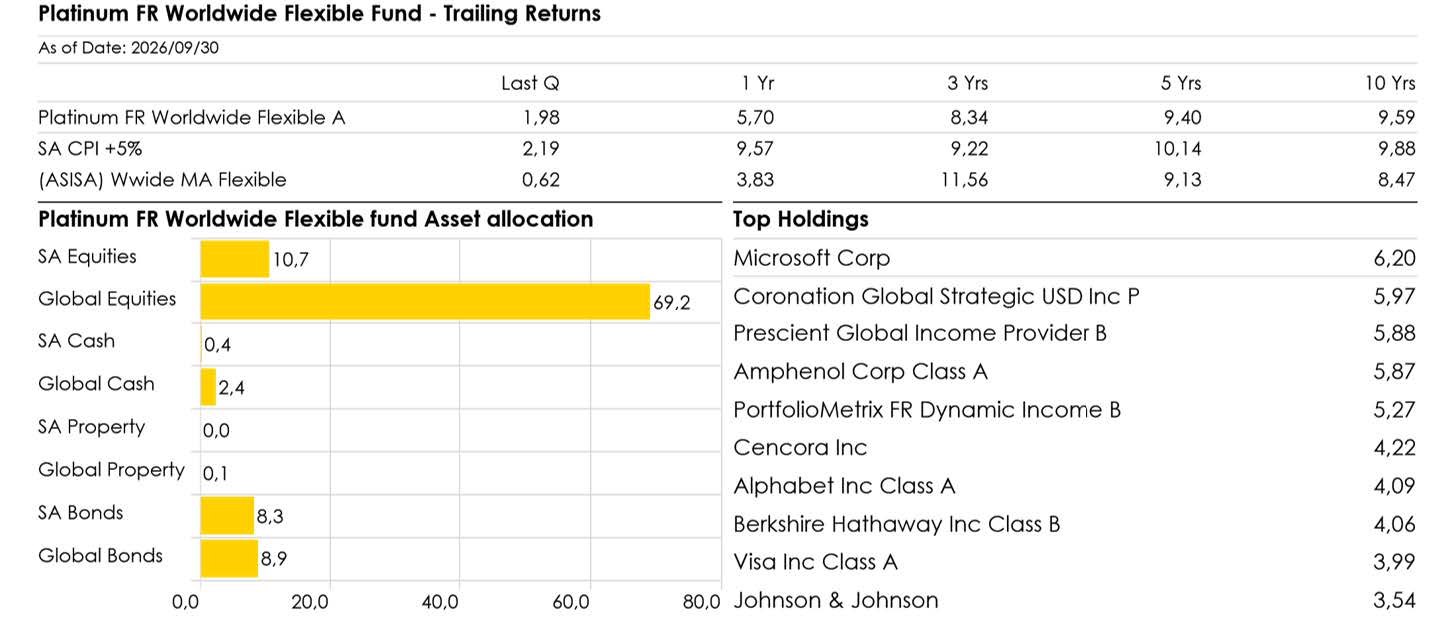
Note: Quarterly performance since inception: Highest 13.17% Lowest -6.68%. Annualised return is weighted average compound growth rate over the period measured. Actual annual figures are available to the investor on request. Source Morningstar as at 30 September 2026.
The Platinum Fund of Funds
The third quarter was mixed for the Fund of Funds range as three of the four funds ended positive, while the Balanced Plus FoF, which has the highest exposure to SA equities, finished negative after local equities fell sharply in September.
- The Platinum FR Balanced Plus FoF returned −0.5% for the quarter.
- The Platinum FR Balanced FoF returned +1.1%.
- The Platinum FR Income Provider FoF returned +1.2%.
- The Platinum FR Defensive Income FoF returned +1.2%.
Against their peers, the Balanced and Income Provider funds both finished in the top 15% of their ASISA categories for the period, together with the Defensive Income funds ending the quarter ahead of its category average.
Income managers faced a difficult quarter. The All-Bond Index lost 0.7% as the SARB turned more hawkish and bond yields rose, while cash returned 1.7%. Against this backdrop, the Granate Multi Income Fund and the Nedgroup Flexible Income Fund each held up well, returning approximately 1.3%. PortfolioMetrix Dynamic Income was the laggard, returning 0.2%.
Our local equity managers delivered sharply contrasting returns. Fairtree was the best performer (+3.3%) benefiting from the July–August rally in gold and PGM counters. 36One returned +2.4%, supported by its holdings in platinum miners and Anglo American. Amplify and Truffle were negative for the quarter lagged the market (-0.3%), as both were heavier in banks and in Naspers and Prosus (which fell over the quarter) and lighter in the resources shares that rallied. Sasol rallied sharply (+41.8%) with oil prices and was a strong contributor for the funds.
Looking ahead, we are making changes within our SA Equity stable. Fairtree is making way for Visio and we are using this as an opportunity to reweight managers within the equity blend. We remain neutral on equities, but we are monitoring specific market dynamics, including rates, oil, gold and the November elections, for any indication that a more bearish stance may be warranted.
The September sell-off is a reminder of why the range is diversified across managers, asset classes and regions. We will continue to look for opportunities as they present themselves, while remaining prudent and avoiding reactive shifts in the absence of greater certainty.
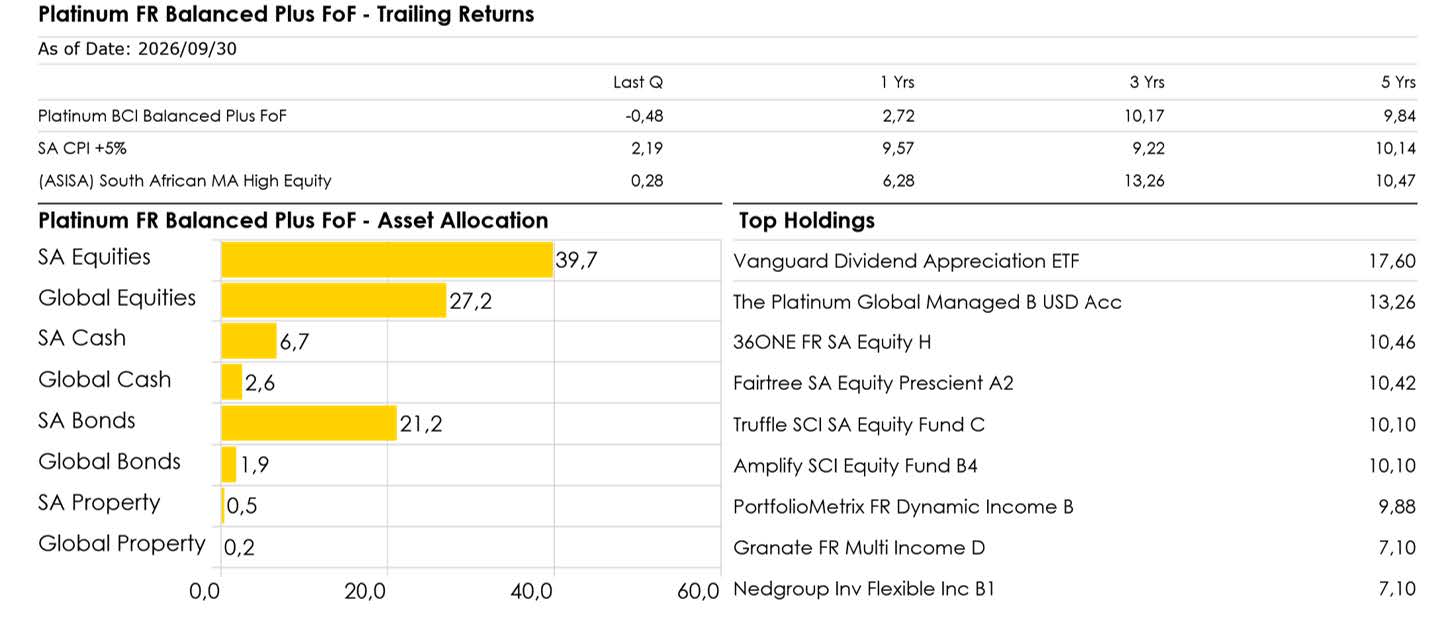
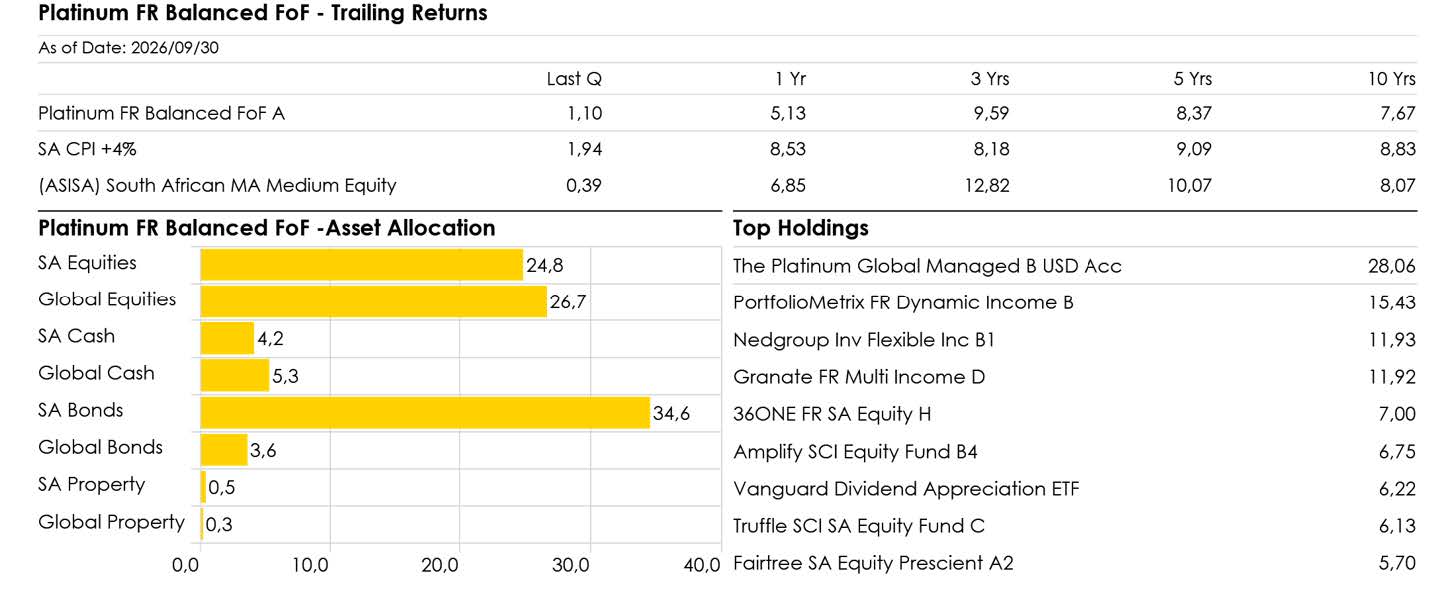
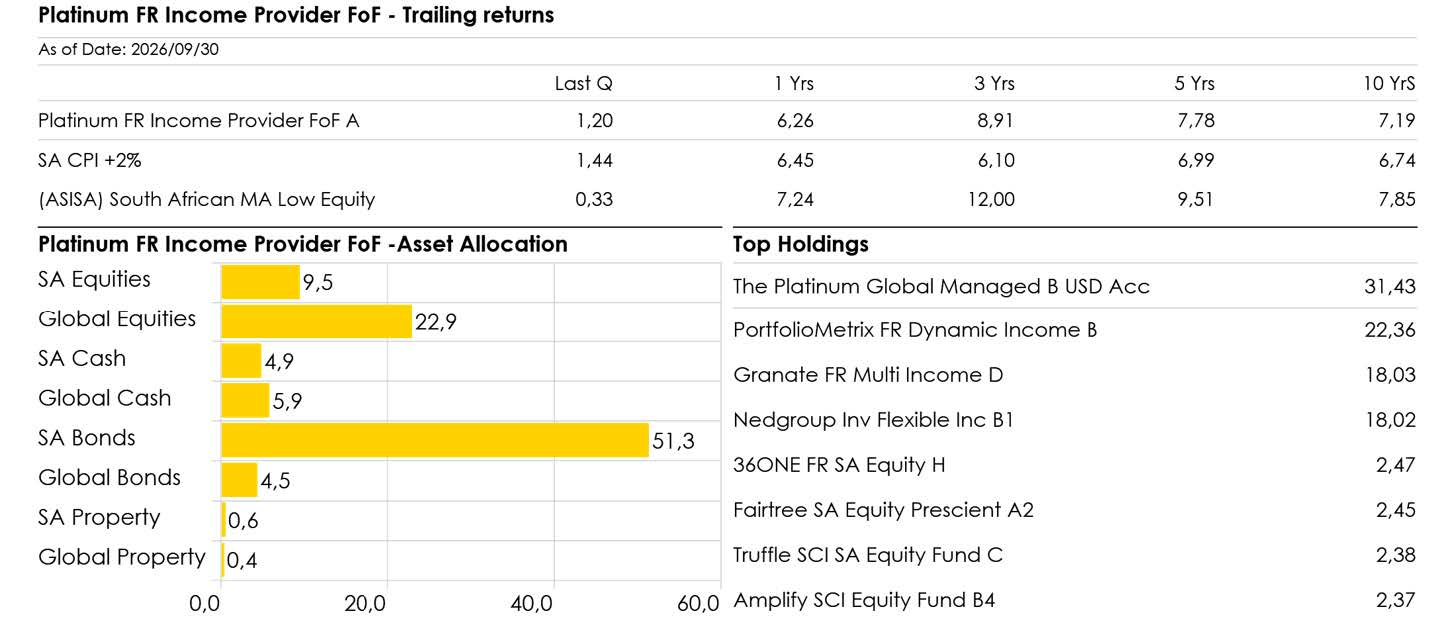
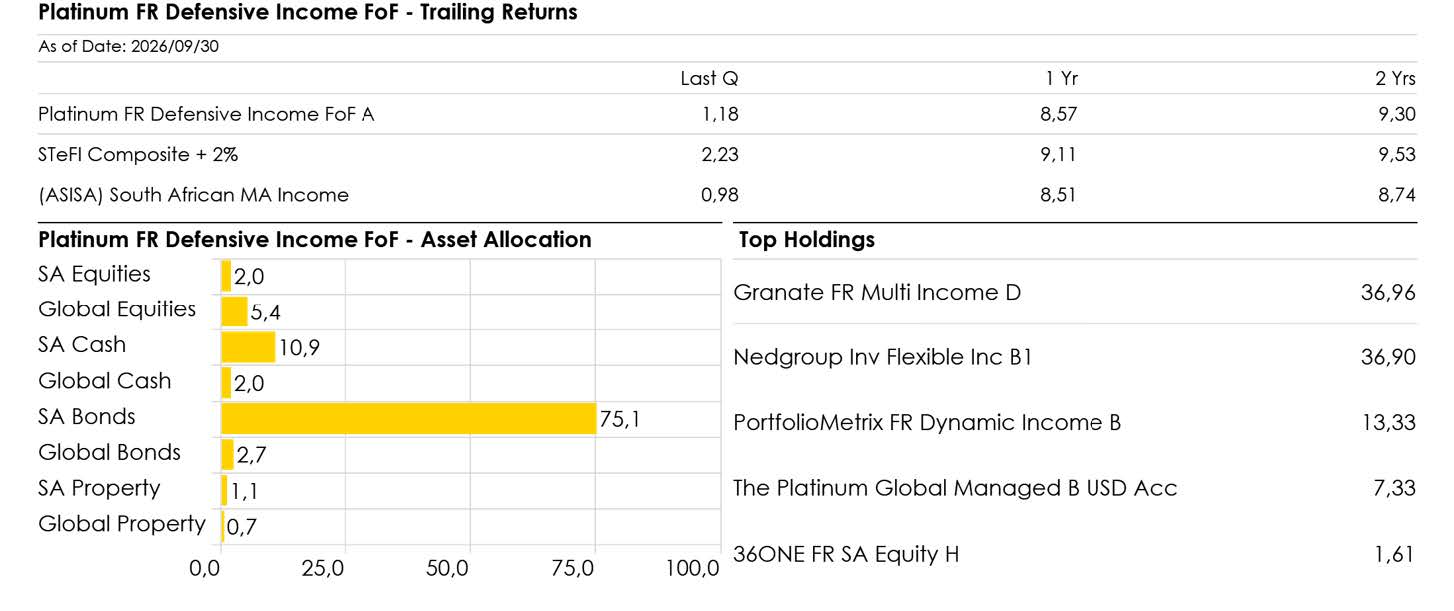
Note: Quarterly performance since inception: Platinum FR Balanced Plus fof Highest 5.05 Lowest -1.71 Platinum FR Balanced Highest 8.62 Lowest -3.90 Platinum FR Income Provider fof Highest5.28 Lowest -1.84. Platinum FR Defensive income fof Highest 3.50 Lowest 0.23. Annualised return is weighted average compound growth rate over the period measured. Actual annual figures are available to the investor on request. Source Morningstar as at 30 September 2026.
Platinum Global Managed Fund
The third quarter of 2026 was the quarter in which the cost of money returned to centre stage. Against this backdrop the Platinum Global Managed Fund delivered a return of 2.13%, more than double its benchmark of US CPI +4%, which returned 0.95%, and well ahead of its Morningstar peer group average of 0.61%.
Market Context
Strong earnings carried the fund through July and August, and the S&P 500 reached a record high in mid-August. Sentiment turned in September. Inflation picked up, oil climbed back above $ 100 a barrel, and on 16 September the US Federal Reserve raised rates for the first time since 2023, to a range of 3.75% to 4.00%. The 10-year Treasury yield rose to around 5.2%.
Warren Buffett compared interest rates to gravity. The higher they are, the harder they pull on the value of every asset. Today every share must compete with a near risk-free return above 5%, and our fair value models reflect this through a higher discount rate. When money is no longer free, the price you pay matters more than ever.
Performance Drivers
A split within AI. Companies putting AI to work, led by Microsoft, Meta and Apple, rose strongly, as did Fortinet on rising demand for cybersecurity. Hardware suppliers Cisco and Amphenol paused after strong runs.
Healthcare carried the fund. Every healthcare holding except Zoetis rose, led by Amgen, Abbott Laboratories and Cencora.
Rising yields weighed on defensives. McDonald’s, Walmart and Colgate-Palmolive, steady bond-like businesses, were marked down as bond yields rose. All three had enjoyed strong runs, and their fundamentals remain intact.
Portfolio Activity
In August we sold PepsiCo, where we saw little prospect of real returns, and used the proceeds to buy Broadcom, a near-essential supplier to the world’s data centres. We also topped up Zoetis, which we believe the market now undervalues. In September we trimmed Johnson & Johnson as it reached the trim price we had set in advance, and reduced Walmart, whose valuation had become stretched.
Positioning and Outlook
Equity exposure ended the quarter at 72.5%. The higher 17.7% cash figure on our factsheet largely reflects a change in Morningstar’s methodology, which now reports our short-term US Treasuries as cash rather than bonds. Our positioning is unchanged, and this defensive portion now earns a meaningful return.
We expect our companies to deliver strong earnings again this reporting season, but we will watch closely for the impact of higher inflation, borrowing costs and supply disruptions on profit margins, which sit near record levels. We are comfortable with our current equity exposure but have a clear plan to reduce it should conditions deteriorate. Volatile markets also create opportunities, and we are well placed to act on them.
Our approach has not changed. We own high-quality companies with durable competitive advantages, strong balance sheets and dependable cash flows, buy them only below fair value and manage risk to deliver consistent real returns over time.
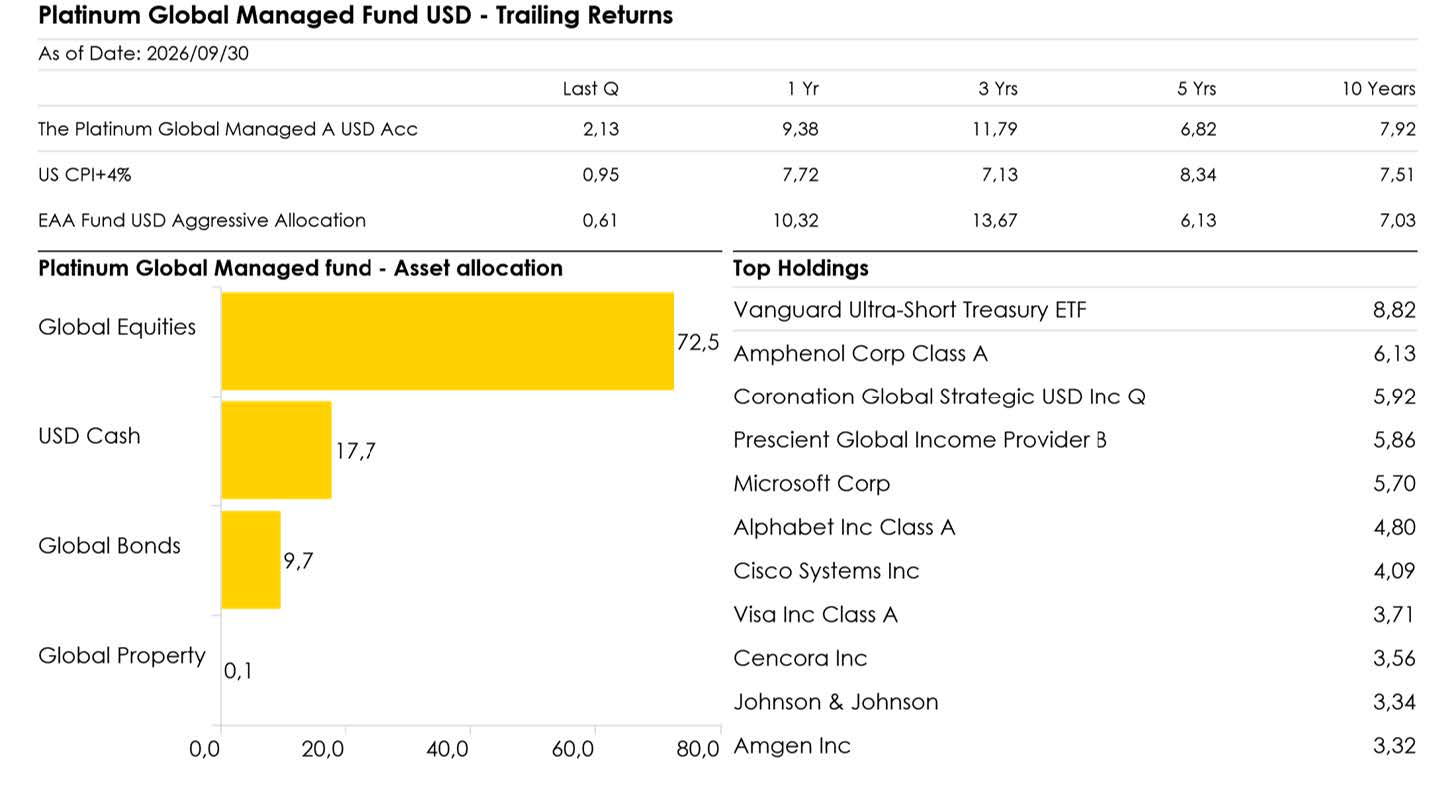
Note: Quarterly performance since inception: Highest: 16.11% Lowest: -8.98%. Annualised return is weighted average compound growth rate over the period measured. All performance figures quoted are sourced from Morningstar. Period ending 30 September 2026.
Broadcom: Quality, Growth and a Wide Economic Moat

One of the recent additions to the Platinum Global Managed Fund is Broadcom, a company that may not be as familiar to investors as some of the world’s largest technology brands, but which plays a critical role behind the scenes in the global digital economy.
Broadcom is one of the world’s leading semiconductor and infrastructure software companies. In simple terms, its technology helps power the networks, data centres, smartphones, cloud platforms and business systems on which the modern economy increasingly depends. Its products are used across networking, wireless connectivity, data storage and enterprise software, while the company has also become an increasingly important supplier of the specialised technology required to build artificial intelligence infrastructure.
What makes Broadcom such a good business?
At Platinum, we look for companies with strong and sustainable competitive advantages – what we refer to as an economic moat. Broadcom is an excellent example. Many of its semiconductor products are highly specialised, technologically complex and deeply embedded in its customers’ systems. Developing competing technology requires considerable expertise, research and investment. In its software businesses, customers often rely on Broadcom’s products to operate important parts of their technology infrastructure, making switching to another provider both costly and disruptive. These advantages have allowed Broadcom to build leading positions in a number of attractive markets. Importantly, Broadcom is not simply a business with exciting technology. It is an exceptionally well-run company with a strong focus on profitability and cash generation. Management, led by CEO Hock Tan, has demonstrated a disciplined approach to allocating capital, investing in its strongest businesses and successfully acquiring and improving other technology companies.
Positioned for the growth of AI
Artificial intelligence has created another significant growth opportunity for Broadcom. The enormous computing power required for AI depends not only on processors, but also on the networking technology that allows thousands of processors within data centres to communicate efficiently. Broadcom is a leader in this area and also works with some of the world’s largest technology companies to design specialised AI chips for their particular requirements.
The growth has already become meaningful. Broadcom reported that AI semiconductor revenue reached $10.8 billion in its second quarter of 2026, an increase of 143% from the previous year, driven by demand for custom AI accelerators and networking products. While this provides Broadcom with an exciting long-term growth opportunity, our investment case is broader than AI alone. We are investing in a diversified, highly profitable technology company with strong competitive positions across semiconductors and infrastructure software
Why Platinum invested
Finding a great company is only the first part of our investment process. The price we pay for that company matters just as much. Broadcom had been on our radar as a high-quality, wide-moat business, but we were not prepared to invest at any price. Periods of market concern surrounding competition and the sustainability of AI growth subsequently created an opportunity for us to establish a position at a price that we believed was below the company’s underlying fair value.
This is precisely the type of opportunity we look for: a high-quality company with durable competitive advantages, strong cash generation and attractive long-term growth prospects, purchased when the market gives us an attractive entry point. Broadcom will undoubtedly experience periods of volatility. Expectations surrounding AI are high, the company has exposure to several very large customers and rapid technological change remains an inherent risk within the industry. Quality does not eliminate risk, which is why valuation and position sizing remain important.
Nevertheless, we believe Broadcom has the characteristics we seek in a long-term investment: a wide economic moat, excellent management, strong cash generation, structural growth opportunities and, importantly, an attractive entry valuation. It is a good example of the discipline at the heart of the Platinum investment philosophy: own quality businesses, understand the risks, and be patient enough to buy them at the right price.