Global Market Commentary
Markets Show Resilience Amid Ongoing Global Uncertainty
After a shaky start to 2025, U.S. equity markets rebounded strongly in the second quarter. The S&P 500 Index surged by 10.6% between April and June, reaching a new all-time high. This impressive recovery followed a nearly 19% correction from mid-February to early April, triggered by tariff concerns and rising geopolitical tensions. As we highlighted in our previous commentary, uncertainty remains a constant in today’s investment environment.
Trade Tensions Ease, Boosting Market Sentiment
The primary catalyst behind the rebound was a de-escalation in trade tensions. Encouraging developments in U.S.-China negotiations and a pause in reciprocal tariffs helped restore investor confidence. Although the global outlook remains uncertain, with a major tariff deadline in July and continued unrest in the Middle East, markets responded positively to greater clarity and stronger-than-expected corporate earnings.
Earnings Drive Gains Amid Sector Rotation
Corporate earnings outperformed expectations in Q2, particularly in the technology sector, which rebounded after underperforming earlier in the year. Conversely, defensive sectors like Healthcare and Consumer Staples lagged, suggesting a renewed appetite for growth-oriented investments. While sector performance varied, overall investor sentiment showed marked improvement.
AI Momentum and Mega-Cap Tech Valuations
The continued enthusiasm for artificial intelligence has been a key driver of U.S. equity gains, especially among mega-cap tech names. However, these stocks’ performance has outpaced their earnings growth, resulting in elevated valuations.
Slowing Economic Momentum and Fiscal Outlook
Beneath the market’s surface, signs point to a slowing U.S. economy. Although the recently passed reconciliation bill is expected to inject stimulus in early 2026, the effects may be temporary. As stimulus fades and structural challenges, such as higher tariffs and declining immigration—persist, growth could weaken again in the second half of 2026.
Labor Market Outlook
A slowing economy will likely translate into weaker job creation, with average monthly pay-roll growth expected to dip below 100,000 for the remainder of 2025. However, a shrinking labour force, due in part to tighter immigration policies, may help prevent a significant rise in unemployment.
Tariffs and the Inflation Trajectory
While tariffs have captured headlines, their inflationary impact has yet to materialize fully. Headline CPI rose just 2.4% year-over-year in May, one of the lowest readings since early 2021. However, inflationary pressures are expected to build as tariff costs filter through retail channels. Inflation could climb to 3.5% by year-end before gradually easing to the Federal Reserve’s 2% target in late 2026.
The Fed Remains on Hold
Amid policy uncertainty and pending inflation developments, the Federal Reserve has kept interest rates on hold throughout the first half of the year. Unless inflation rises meaningfully and unemployment remains contained, the Fed is likely to remain cautious, potentially delivering only one rate cut in 2025.
Fixed Income Outlook: Favouring Quality
Despite slowing growth, inflation risks, and policy uncertainty, fiscal stimulus expectations and a patient Fed may support a floor under long-term interest rates. This environment does not favour aggressive bets on either duration or credit. However, today’s higher starting yields suggest that high-quality bonds and short dated government debt may still offer attractive returns over time.
Currency Market: U.S. Dollar Under Pressure
The U.S. dollar has weakened significantly since January, weighed down by its rich valuation, concerns over foreign concentration in U.S. assets, and shifting government policies. While short-term downside may be limited, especially if global central banks ease more aggressively than the Fed, the dollar is likely to remain under pressure longer term, as growth slows and trade imbalances persist.
Conclusion
Looking ahead, investors must navigate a complex environment marked by elevated valuations in certain segments, rising policy and inflation uncertainty, and a Federal Reserve that is likely to remain on pause. Diversification, discipline, and a focus on quality remain essential. While the path forward may be uneven, opportunities continue to exist for thoughtful, long-term investors, particularly in areas of the market that offer resilient earnings, attractive valuations, and sound fundamentals. As always, we remain committed to guiding our clients through changing con-ditions with a clear, long-term perspective.
South African Market Commentary
Downward Revisions to GDP Growth
South Africa’s GDP growth forecasts for 2025 faced significant downward revisions, reflecting structural and external pressures. The South African Reserve Bank (SARB) lowered its 2025 projection to 1.2% from 1.7%, Manufacturing also weakened, with the Absa PMI falling to 44.7, signalling further contraction. S&P Global Ratings revised its forecast to 1.3% from 1.8%, pointing to fiscal vulnerabilities, with national debt projected to exceed 78% of GDP by 2026/27, and export disruptions from US tariffs. The IMF has revised South Africa’s 2025 GDP growth forecast downwards to 1.0%, a decrease from the previous estimate of 1.5%. This revised forecast suggests a slower pace of economic expansion for South Africa in the near future. The World Bank’s estimate of 1.8% was optimistic, with other forecasts as low as 1.5%, down from earlier 2.0% projections.
US Dollar Weakness and Trump Policies
The Rand seemingly displayed strength throughout this year, appreciating 2.30% against the US Dollar over the quarter, and 3.75% year-to-date, briefly trading below 17.50 against the greenback at one point. However, this is mainly due to Dollar weakness linked to US President Donald Trump’s policies. Trump’s aggressive tariffs, unpredictable trade policies, and massive $3.3T spending bill eroded investor confidence, leading to a 10.8% drop in the US dollar. To put this in perspective, the Rand has depreciated by approximately 3% against the British Sterling and over 6% against the Euro this year thus far.
GNU Tensions and Deputy Minister Firing
The Government of National Unity (GNU) faced significant strain following President Cyril Ramaphosa’s dismissal of Democratic Alliance (DA) Deputy Trade Minister Andrew Whitfield in June 2025 over an unauthorized US trip. The DA, a key coalition partner, issued a 48-hour ultimatum demanding the removal of ANC ministers accused of corruption, threatening to withhold budget support. This escalated tensions after the DA opposed the 2025/26 budget’s VAT hike, forcing the ANC to rely on smaller parties to pass it. The rift, compounded by ideological differences over issues such as land reform and economic policy, raised fears of coalition collapse, potentially weakening South Africa’s negotiating stance with the US and deterring investors.
The Endurance of Grit: Lessons from Steve Redgrave and Angela Duckworth

At Platinum, our job is not a sprint, it’s a marathon. Day after day, we rise to meet the markets with discipline, focus, and resolve. This isn’t about talent or lucky streaks, it’s about grit. Angela Duckworth defines grit as a blend of passion and perseverance for long-term goals. In our world, managing wealth across decades, grit is not optional. It’s the foundation.
No one embodies this more than Sir Steve Redgrave, Britain’s greatest Olympian. His career is not just a highlight reel of victories; it’s a masterclass in grit, the exact kind of mental and emotional resilience we strive to emulate in how we manage money for our clients.
What Is Grit?
Duckworth argues that grit—not talent—is the true driver of long-term success. Grit is the never-quit attitude. It’s waking up every day with purpose, even when the odds are stacked against you. It’s passion maintained over years, and perseverance that pushes through discomfort, frustration, and setbacks.
Redgrave’s story is grit personified.
He didn’t win five consecutive Olympic gold medals from 1984 to 2000 by chance. He won them through pain, sacrifice, and relentless effort, fighting against diabetes, ulcerative colitis, and the crushing weight of expectation. After his fourth gold in Atlanta in 1996, he famously said, “If anyone sees me go near a boat again, you have my permission to shoot me.” His body was broken. His mind was exhausted.
But of course, he came back. Why? Because grit doesn’t quit.
Talent vs Effort
Duckworth challenges the way society idolises talent. She explains that talent might explain how fast you learn a skill, but effort determines how far that skill takes you. In fact, she writes:
“Talent counts once, effort counts twice. Effort builds skill. Effort makes skill productive.”
This resonates deeply in fund management. Markets are unpredictable, and there’s no shortcut to long-term per-formance. Success in investing is not about guessing right once. It’s about consistency, discipline, and process—putting in the hours, refining strategies, learning from mistakes, and never letting up.
At Platinum, we don’t see ourselves as ‘gifted’ or possessing some miraculous skill. What we do have is endurance. The daily work. The discipline. The commitment to keep showing up for our clients, even in volatile markets.
Redgrave’s Legacy: The Grit Behind the Gold
In 2000, at 38 years old—far past the prime for most athletes—Redgrave returned one last time. He joined the coxless four, and despite immense pressure and physical toll, stormed to victory in Sydney, becoming the first Brit to win gold at five consecutive Games.
His reward? Not just a medal, but a special Olympic gold pin from IOC President Juan Antonio Samaranch, reserved for achievements beyond the ordinary. It wasn’t given for winning. It was given for enduring.
We believe managing wealth is no different. It’s not about one good year. It’s about enduring—through market cycles, global shocks, and uncertainty—and still delivering results that matter.
Applying Grit to Fund Management
At Platinum, our process is built around grit:
- Passion: We’re obsessed with investing. We care deeply about protecting and growing our clients’ capital.
- Practice: Every day, we refine and repeat our process, reviewing positions, reassessing risk, improving our edge.
- Purpose: Our purpose is clear—helping clients achieve their long-term objectives, not just quick wins.
- Hope: Not blind optimism, but informed belief that with effort, focus, and discipline, we can continue to deliver.
Duckworth writes:
“One form of perseverance is the daily discipline of trying to do things better than we did yesterday.”
That’s our culture. Quietly relentless. Endlessly curious. Never complacent.
A Note to Our Clients
Grit is not just something we need. It’s something our clients need too. Staying invested over decades takes courage, especially when markets test your resolve. But with a shared long-term mindset and trust in a disciplined process, we can help you reach your financial goals.
You don’t need to be an Olympian. But like Redgrave, you do need to keep going, even when it’s hard.
Conclusion: Why Grit Matters More Than Ever
In a world where markets change fast and uncertainty dominates headlines, grit gives us a foundation to stand on. It’s not glamorous, but it works. Talent may open the door, but effort, discipline, and endurance are what carry you across the finish line.
At Platinum, we’ve built our business not on promises, but on perseverance. Because like Redgrave, we’re not in it for the moment. We’re in it for the legacy.
Report back on our funds
The Platinum BCI Worldwide Flexible Fund
Despite ongoing uncertainty and market volatility, the Fund delivered a positive return in US dollars of over 5% and ended the quarter up 1.56% in rands. Given the challenges we’ve seen so far this year, this is a result we are satisfied with – and it reflects the strength of the companies we invest in and our disciplined approach.
A Strong Rand and a Weaker Dollar
One of the key developments in 2025 has been the over 6% weakening of the US dollar against the rand. While currency moves like this can affect offshore returns, the companies we invest in are well positioned to weather these changes. These are large, global businesses that earn in many currencies and operate across multiple regions – they’re built to perform through cycles.
Our Companies Delivered
A major highlight for us is that around 80% of the companies in the Fund reported stronger-than-expected earnings in the first six months of the year. This shows the quality of the businesses we own — they continue to grow, innovate, and reward shareholders, even in uncertain times.
Some of our top contributors included Philip Morris, Amgen, Berkshire Hathaway, and Visa. Our newer additions, Meta and Alphabet, also added positively after we bought them at attractive prices during the March market pullback.
The standout performer was Amphenol, which is up over 42% year-to-date. It’s an excellent example of the kind of business we like resilient, consistent, and positioned in growth industries like technology and communications.
What’s Happening Globally?
The year began on a positive note, but things changed quickly. The return of President Trump brought new political uncertainty, especially around trade and foreign policy. This caused a drop in US markets in March. However, markets outside the US did better:
Europe strengthened, especially Germany, thanks to higher government spending. China saw a tech recovery, supported by new developments in AI. Gold hit a record high as investors looked for safety. Bonds, especially US Treasuries, also delivered good returns.
During the first half of the year, we increased our equity exposure slightly (by 2.6%), taking advantage of opportunities where we saw value.
Looking Ahead
We expect continued market volatility in the second half of the year. Volatility often gives us the chance to buy quality companies at good prices. That’s where long-term value is created for our clients.
We remain confident in the companies we own. They have strong balance sheets, global reach, and proven management teams. They’ve delivered through uncertainty before and we believe they’ll do it again.
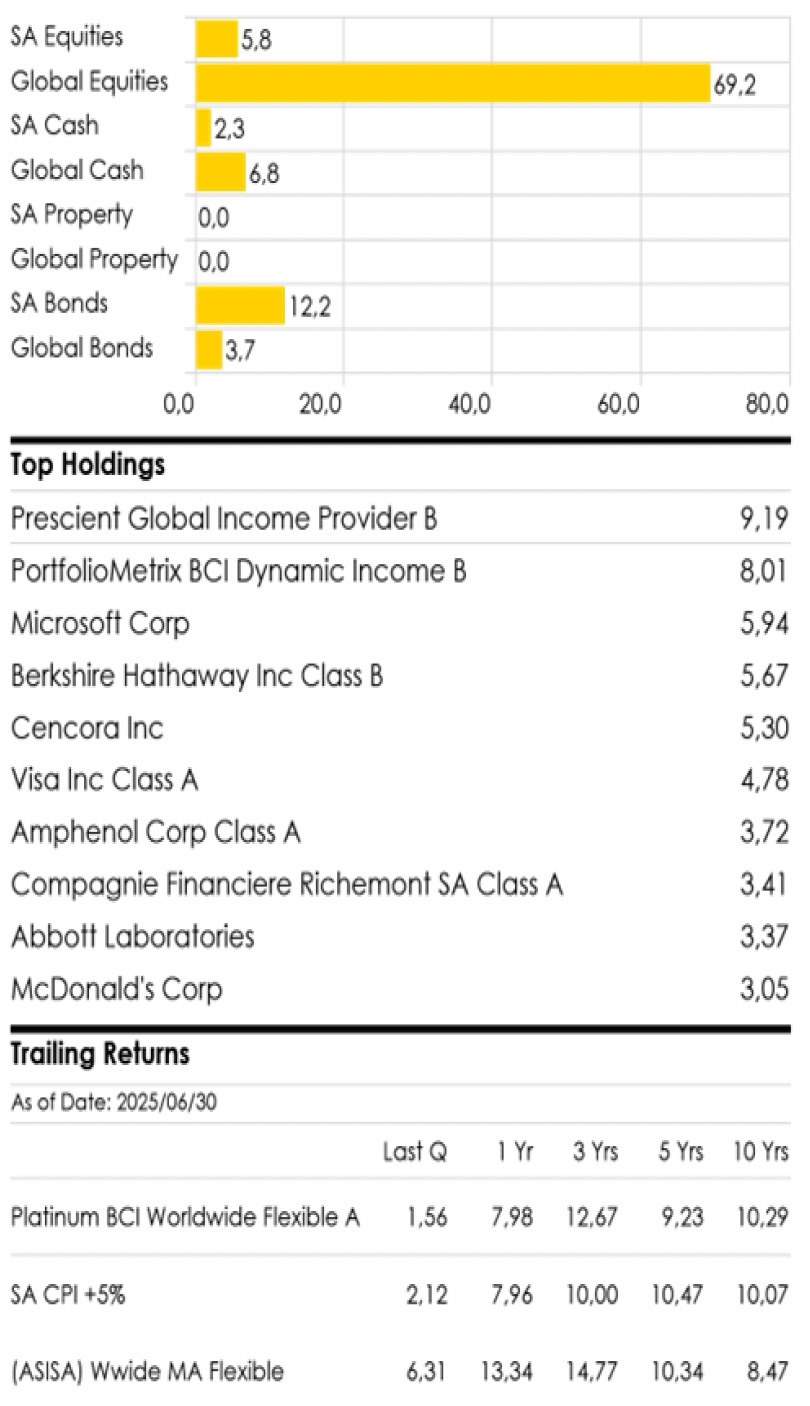
Note: Quarterly performance since inception: Highest 13.17% Lowest –6.68%. Annualised return is weighted average compound growth rate over the period measured. Actual annual figures are available to the investor on request. Source Morningstar as at 30 June 2025.
The Platinum BCI Balanced Plus Fund of Funds
The Platinum BCI Balanced Fund of Funds
Platinum BCI Income Provider Fund of Funds
New Fund Launch: Enhancing Our Investment Offering
In June this year, we successfully launched the Platinum BCI Balanced Plus Fund of Funds. This new fund completes our comprehensive suite of investment solutions, tailored to meet the diverse financial goals of our clients. With a specific focus on retirement savings, it is designed to offer long-term growth, stability, and peace of mind for investors seeking to secure their financial future.
Outlook on South Africa and Equity Positioning
During the second quarter, we maintained our cautious stance on South Africa’s economic growth prospects and the resulting implications for local equities. Although policymakers occasionally promote a business-friendly narrative, we have yet to see meaningful progress in terms of policy implementation. In comparison to global multinational companies that benefit from stronger economic environments, we continue to favour offshore equities and remain overweight in that area.
Currency Impact and Fund Performance
The recent weakness in the US dollar, along with a stronger rand, marginally reduced the strong hard currency returns from our offshore investments. Nevertheless, both the Platinum BCI Balanced Fund of Funds and the Platinum BCI Income Provider Fund of Funds outperformed their respective benchmarks during the quarter.
Strategic Shift in Fixed Income Allocation
Looking ahead, concerns over a constrained corporate environment, compressed credit spreads, and a lack of new credit supply have led us to adjust our fixed income strategy. We are reducing exposure to credit-focused strategies in favour of longer-dated nominal bonds, which offer similar yields with lower default risk. By early July, we will exit the Aluwani High Yield Fund and reallocate capital to the Portfoliometrix BCI Dynamic Income Fund and the Nedgroup Investments Flexible Income Fund.
The Platinum BCI Defensive Income Fund of Funds
The Platinum BCI Defensive Income FoF delivered a creditable performance, surpassing its SteFI+2% benchmark. The fund capitalized on a favourable yield environment, with short-dated nominal bonds offering attractive returns as market sell-offs pushed yields above money market equivalents. Strategic allocation to these bonds, combined with a conservative approach to credit and duration risk, drove outperformance. Compared to peers, the fund’s low-duration strategy provided stability in a quarter marked by uncertainty over fiscal policy and GDP growth projections. This outperformance underscores the fund’s ability to navigate a complex macro landscape, delivering consistent income and capital preservation for risk-averse investors.
Looking forward, we remain cautious about corporate conditions, credit spread compression, and limited credit supply. Consequently, we are shifting to longer-dated nominal bonds for higher yields with significantly lower default risk. In early July, the fund will exit the Aluwani High Yield and Fairtree BCI Income Plus Funds, reallocating to the Portfoliometrix BCI Dynamic Income and Nedgroup Investments Flexible Income Funds to enhance stability and income potential.
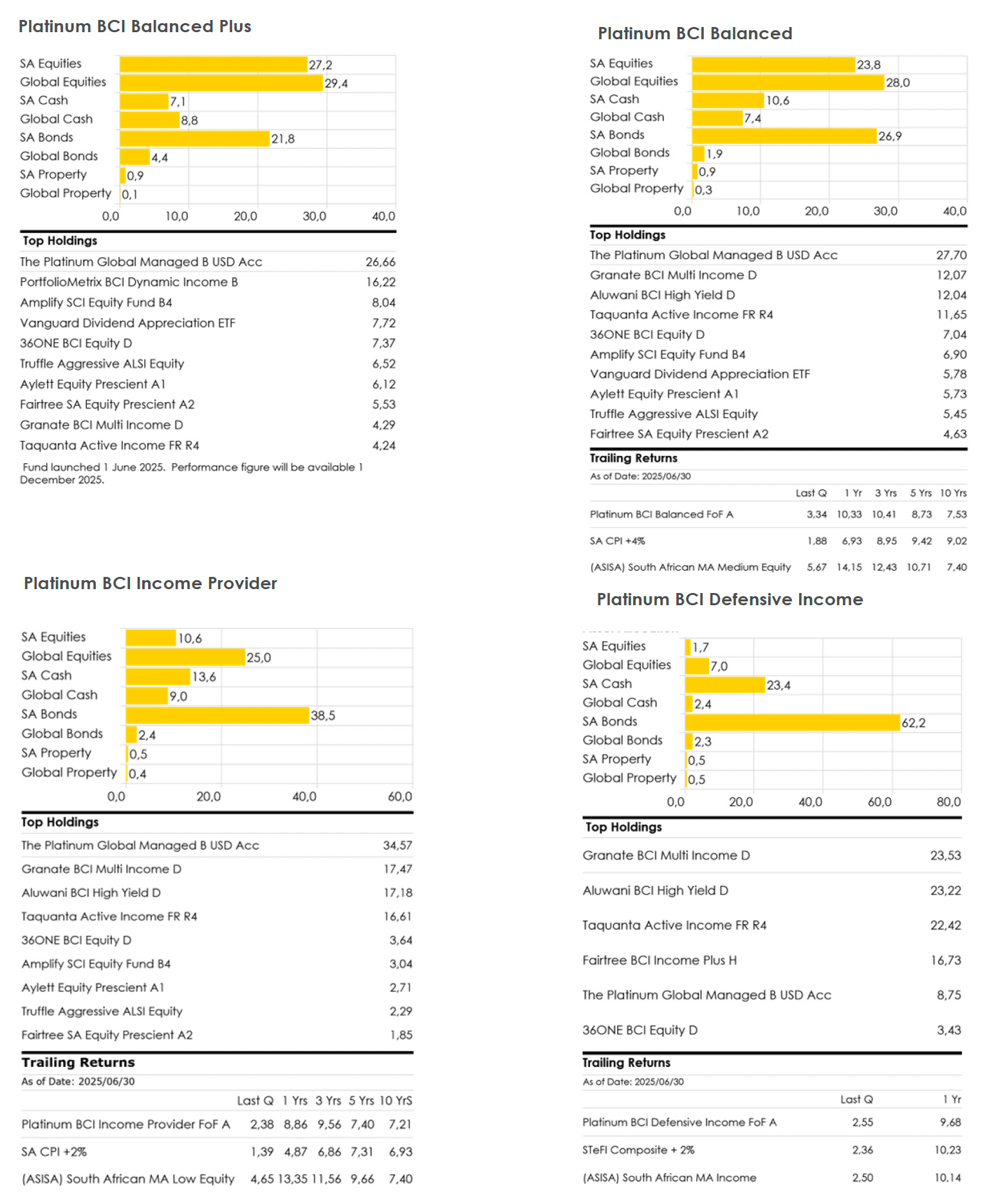
Note: Quarterly performance since inception: Platinum BCI Balanced fund: Highest 8.62% Lowest –3.90%. Platinum BCI Income Provider fund: Highest 5.28% Lowest –1.84%. Annualised return is weighted average compound growth rate over the period measured. Actual annual figures are available to the investor on request. Source Morningstar as at 30 June 2025.
Platinum Global Managed Fund USD
The Platinum Global Managed Fund delivered a solid return of 3.2% for the quarter, comfortably outperforming its benchmark, US CPI + 4%, which was 1.7% over the same period.
Market Context: Cautious Optimism Amid Policy and Tariff Uncertainty
Uncertainty remains a central theme in recent Federal Reserve communications, driven largely by concerns over escalating trade tariffs and their potential inflationary impact. Earlier in the quarter, market sentiment wavered due to fears of a slowdown in AI infrastructure investment and the possibility of new tariffs. However, confidence quickly returned following the postponement of further tariff hikes and reassurances from major U.S. tech companies affirming their ongoing commitment to capital expenditure.
Valuation Challenges and Our Disciplined Approach
Although headline indices may appear overvalued, not all stocks are overpriced. Certain segments, such as biotech, have been left behind and may present future opportunities. At present, however, we are finding fewer stocks that meet both our quality criteria and valuation thresholds. We remain disciplined and patient, setting clear price targets for high-quality businesses and waiting for the right entry points. As Warren Buffett has demonstrated, holding cash is a valid strategy when value is scarce.
Making Our Cash Work Harder
In light of this, we’ve taken proactive steps to enhance the yield on our cash holdings without significantly increasing risk. During the quarter, we made a meaningful allocation to the VGUS ETF, which provides exposure to short dated U.S. government bonds. This investment helps us earn a higher return on idle capital while we wait for attractive equity opportunities to emerge.
Top Contributors to Performance
- Amphenol: Delivered strong quarterly results, supported by resilient demand across automotive, industrial, and military sectors.
- Microsoft: Benefited from continued strength in Azure cloud services and accelerating AI-driven growth.
- Texas Instruments: Recovered well as demand rebounded in the industrial and automotive chip markets.
Key Detractors
- Zoetis: Disappointed as sales growth in its companion animal segment lagged expectations.
- PepsiCo: Reported weaker volume growth and was impacted by rising input costs, pressuring margins.
Looking Ahead
We continue to manage the fund with a long-term mindset, staying focused on capital preservation. While near-term opportunities remain limited, we believe that patience, discipline, and preparation will serve our investors well when the next wave of attractive valuations presents itself.
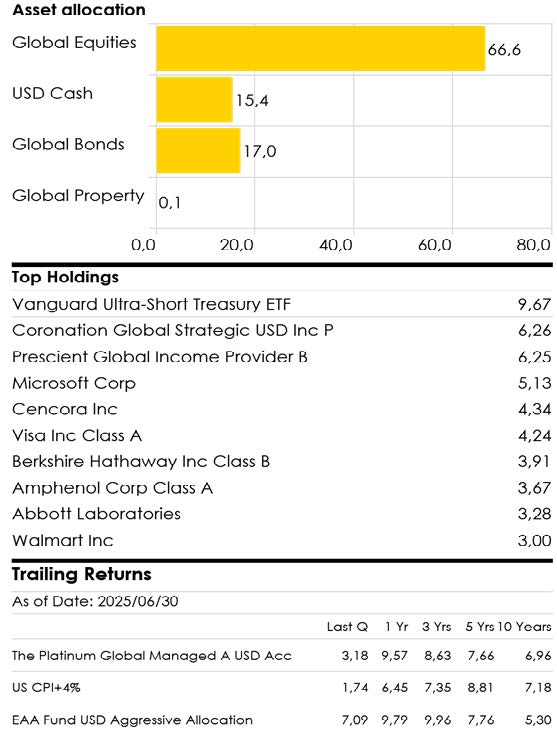
Note: Quarterly performance since inception: Highest: 16.11% Lowest: -8.98%. Annualised return is weighted average compound growth rate over the period measured. All performance figures quoted are sourced from Morningstar. Period ending 30 June 2025. Actual annual figures are available to the investor on request.
Insights
The Power of the Pride: Lessons in Leadership and Teamwork from the Animal Kingdom
Insights from our recent IFA event with guest speaker Ian Thomas
 At our recent event for Independent Financial Advisor partners, we were delighted to welcome Ian Thomas as our guest speaker. A celebrated author and highly engaging presenter, Ian is best known for his book Power of the Pride, in which he draws powerful parallels between lion behaviour in the wild and human dynamics within high-performing teams.
With his characteristic energy and storytelling flair, Ian captivated the room, reminding us that nature has much to teach us, especially when it comes to leadership, collaboration, and performance.
Here are some of the key insights he shared:
Strong Individuals Build Strong Teams
In a pride of lions, success starts with the strength of each member. Females are the primary hunters, while males protect the territory, but it’s the collective strength that ensures survival. In the same way, great teams are built by developing each person’s unique capabilities.
Know and Own Your Strengths
Every lion knows exactly what they’re good at. In business, individuals should not only understand their strengths but be able to clearly communicate them. Self-awareness and role clarity drive performance.
Trust and Focus Drive Success
When lionesses hunt, they operate with absolute focus and trust in one another. Each has a defined role and unwavering confidence in her teammates. In business, achieving big goals requires the same level of alignment and mutual trust.
Mentorship Matters
Young lions learn through experience, making mistakes, trying again, and always supported by the pride. In organisations, a culture of mentorship and learning is essential for long-term success.
Focus on Contribution, Not Reputation
Lions don’t rest on past victories, their value lies in what they bring to the hunt today. Similarly, great teams are built on current contribution and consistent performance, not titles or history.
Smaller Teams, Greater Impact
The most effective lion prides consist of 5 to 12 members. For business teams, keeping groups small promotes agility, accountability, and sharper execution.
Ian’s thought-provoking talk served as a timely reminder that great teams, whether in the wild or in the work-place are built on trust, clarity, and a shared purpose. His message resonated deeply with our guests, reinforcing our belief that investing in people is one of the most powerful ways to build a successful and sustainable business.