Global market commentary and what we have learned from market cycles.
Global markets delivered an unusually strong and broad-based year in 2025, with a powerful “risk-on” environment lifting almost every major asset class. Despite early-year turbulence driven by US tariff hikes — which briefly knocked developed-market equities down by 16.5%, markets rebounded strongly as fiscal and monetary stimulus took hold. By year-end, developed equities were up 21.6%, and emerging markets surged 34.4% in US dollars. Precious metals were the standout, with gold benefiting from central bank buying and ETF inflows, while silver soared 149%, driving the Bloomberg Precious Metals Index up 80% and helping commodities return 15.8% overall. Global bonds also surprised on the upside, delivering 8.2% in USD as inflation fears eased, yields remained attractive and the US dollar weakened.
Equity markets were shaped by the rise of artificial intelligence and shifting regional leadership. In the US, communication services and technology stocks led the market, returning 33.0% and 23.6% respectively, but only two of the “Magnificent Seven” outperformed the S&P 500 as investors became more selective about who would ultimately benefit from AI. Consumer-facing sectors lagged as softer job growth and concerns over tariff-related de-mand weakness restrained pricing power. While US equities still delivered a solid 17.9% return, they were outpaced by other regions, marking the first time in 20 years that the S&P 500 was the weakest-performing major equity market.
Learning From Market Cycles: Six Signals We Watch Closely
Over the past 25 years, Platinum Portfolios has managed private client money through some of the most challenging market environments in history, from the dot-com crash to the Global Financial Crisis, to the pandemic-driven sell-off. One lesson has been consistent: Major market declines are rarely sudden or unpredictable; the warning signs usually appear well in advance.
Recently, Jamie Dimon, CEO of JPMorgan Chase, shared the key indicators his team monitors to prepare for difficult market cycles. These are not complex models or short-term forecasts, they are simple, repeatable signals that help investors assess when risk in the system is rising. These are the same types of indicators we have monitored at Platinum for many years, as part of our disciplined risk-management framework.
The Six Warning Signals We Monitor
1. Credit market stress
Credit markets often weaken before equity markets do. When lending tightens, borrowing becomes more expensive, and credit spreads widen, it is a sign that economic pressure is building beneath the surface.
2. Aggressive monetary tightening
Rapid interest-rate hikes, inverted yield curves, or shrinking central-bank balance sheets have historically preceded periods of market stress. The pace of change matters as much as the level of rates.
3. Excessive valuations
When asset prices move far ahead of underlying fundamentals, markets become fragile. High valuations reduce the margin for error and increase the risk of sharp corrections.
4. Rising leverage
High levels of debt — whether in households, companies, or financial markets — amplify both gains and losses. Periods of excessive leverage have been at the centre of many past crises.
5. Speculative behaviour and euphoria
When investors believe “this time is different,” chase momentum, or abandon risk discipline, it often signals late-cycle conditions rather than sustainable growth.
6. Broad earnings deterioration
Markets can ignore fundamentals for a time, but earnings matter. Widespread earnings downgrades and cau-tious guidance are often early signs of economic slowing.
How We Use These Signals
These indicators are not timing tools. They do not tell us exactly when markets will turn, and no one can predict that with precision. Instead, when several of these signals begin to align, our focus shifts:
- Reducing unnecessary risk
- Emphasising quality businesses with strong balance sheets
- Preserving capital
- Maintaining flexibility to act when opportunities emerge
This approach may mean missing the final phase of a market rally, but history shows that protecting capital during downturns is far more important to long-term outcomes. By consistently monitoring these six indicators and adjusting portfolios thoughtfully, we aim to guide our clients through both favourable and challenging market environments with discipline, perspective, and care.
Why Is This Important for Clients Today
Markets do not move in straight lines, and the most challenging periods are often preceded by clear but easily ignored warning signs. In today’s environment, marked by higher interest rates, pockets of elevated valuations, and increased uncertainty, understanding where risks are building matters more than trying to predict short-term market moves.
At Platinum Portfolios, our focus is on preparation rather than prediction. By monitoring a small number of proven indicators and adjusting risk thoughtfully, we aim to protect capital during difficult periods while remaining positioned to take advantage of opportunities when markets dislocate.
Experience across multiple market cycles has taught us that long-term outcomes are driven as much by risk management as by returns, especially when conditions become less forgiving.
Local Market Commentary
Overview
South Africa’s economy showed resilience in Q4 2025, closing the year with estimated full-year real GDP growth of around 1%. This modest expansion was bolstered by the near-absence of load-shedding, logistics improvements, and the stabilising influence of the Government of National Unity (GNU) but remains significantly lower than what is required for meaningful job creation, poverty reduction, and reversing the country’s deepening inequality.
Precious Metals Rally Benefits
South Africa reaped significant advantages from the 2025 precious metals boom. Gold prices soared over 65% for the year, reaching record highs above $4,500/oz by year-end, driven by geopolitical tensions, central bank buying, and safe-haven demand. Platinum surged dramatically—up roughly 76% year-to-date in some periods, hitting all-time highs near $2,300+/oz—fuelled by structural supply deficits, hydrogen economy prospects, and substitution effects. Palladium also rose substantially despite EV transition headwinds.
As the world’s leading producer of platinum group metals and a major gold exporter, South Africa saw boosted export revenues, improved mining sector profitability, and rand strength (gaining over 12% against the dollar in 2025). Higher prices supported fiscal inflows and overall commodity export earnings, helping offset weaknesses in other sectors and contributing to economic stability. This has led to South Africa’s newest gold mine, the Qala Shallows Underground Mine, marking the nation’s first new underground gold mine in 15 years.
Outlook for 2026
Current forecasts point to GDP growth of 1.3-1.6% for 2026, aided by ongoing rate easing, logistics gains, and energy reliability. Inflation is expected to stay contained at 3.0-3.5%.
Political risks could disrupt this: The unresolved Phala Phala judgement on President Ramaphosa, with persistent legal challenges, threatens GNU stability and investor confidence. The DA’s April federal congress, amid leadership tensions for John Steenhuisen, risks coalition fractures and reform delays. Local government elections (late 2026) are likely to yield hung councils, potentially hindering service delivery and infrastructure spend.
Strained SA-US relations marked by 30% tariffs on key exports, AGOA uncertainties, and disputes over policies and alliances pose external threats, risking reduced revenues, rand weakness, higher borrowing costs, and JSE pressure.
While the 2025 precious metals rally provided a vital lifeline, South Africa’s 2026 trajectory depends on navigating political turbulence and external frictions. Sustained reforms in energy, logistics, and governance, coupled with diplomatic efforts to preserve trade ties, offer the best path to unlocking higher growth. Failure to maintain stability risks volatility and prolonged low-growth stagnation, underscoring the need for inclusive, decisive leadership to translate commodity windfalls into broader prosperity.
Platinum’s Insights: A Stockdale Moment: Discipline, Reality, and Long-Term Confidence
James Stockdale was a U.S. Navy admiral and fighter pilot who, during the Vietnam War, was shot down over North Vietnam and held as a prisoner of war for more than seven years. During his captivity, he endured extreme hardship, including torture and prolonged isolation. Despite this, he emerged as a leader among fellow prisoners, helping them survive psychologically and maintain dignity under the most brutal conditions.
After his release, Stockdale reflected on why some prisoners endured while others did not. He concluded that survival depended on holding two beliefs at the same time: confronting the brutal reality of the situation, while never losing faith that one would ultimately prevail. This insight became known as the Stockdale Paradox, later articulated by Jim Collins, he is a prominent American business consultant, author, and lecturer widely known for his extensive research into what makes great companies succeed and sustain performance over time. He popularized the Stockdale Paradox in his bestselling book Good to Great.
Applying the Stockdale Paradox to Investing at Platinum Portfolios
Periods of uncertainty and volatility are an inevitable part of investing. Markets move in cycles, sentiment shifts, and short-term outcomes can at times be uncomfortable. In environments like these, it is essential to return to our first principles.
The Stockdale Paradox offers a powerful framework for how we manage money on behalf of our clients. In practical terms, it means we acknowledge reality as it is. We do not ignore market drawdowns, economic headwinds, or periods of heightened risk.
These are the facts, and confronting them honestly is central to sound investment management.
At the same time, we maintain unwavering confidence in the long-term outcome of our process and discipline. This confidence is not based on optimism or market timing, but on rigorous research, disciplined portfolio construction, and our well-tested investment process designed to do well across full market cycles.
History shows that investors who abandon well-researched strategies during difficult periods often compromise long-term returns. The pressure of difficult market conditions causes them to change their philosophy and have scope creep by getting sucked in by the herd. We believe that by remaining discipline and stay the course we will achieve strong real outcomes over time.
Staying the Course with Conviction
We believe we are navigating a Stockdale moment. While near-term conditions may be challenging, our process remains intact. We continue to assess risks objectively, adapt where necessary, and ensure portfolios remain aligned with long-term objectives.
Most importantly, we remain confident that:
- Our research is robust and evidence-based
- Discipline through volatility is essential
- Our process is clearly defined
Time in the market is a critical driver of real returns. By confronting today’s realities while maintaining faith in the long-term outcome, we believe we are best positioned to deliver what matters most to our clients: sustainable, real returns over time. Our commitment is to guide clients through uncertainty with clarity, discipline, and conviction so that, however long it takes, we prevail together.
The Platinum BCI Worldwide Flexible Fund
Fund Performance
The Platinum BCI Worldwide Flexible Fund delivered a strong return of just under 19% in US dollar terms for the 2025 calendar year. In rand terms, however, the fund returned just over 5%, reflecting the impact of currency movements during the year.
Portfolio Positioning and Q4 Adjustments
During the final quarter of 2025, we made selective changes to the equity portfolio as attractive opportunities emerged. We added positions in Standard Bank, Capitec, FirstRand, and Oyster Catcher. As a result of these additions, the fund’s equity exposure increased from the low-70% range to just under 80% by the end of the quarter. These changes were aimed at improving the balance between offshore investments and high-quality local companies.
Quarterly Equity Highlights
Performance during the quarter was driven by a small number of shares. Alphabet was the strongest contributor, recovering from earlier weakness. Standard Bank delivered a strong return shortly after being added to the portfolio, while Amgen also contributed positively following a very good quarter in the biotechnology sector.
The main detractors during the period were Zoetis, Microsoft, and Williams-Sonoma, which experienced share price weakness.
Market Volatility and Recent Developments
Market volatility increased toward the end of the quarter following new policy announcements by President Trump, which unsettled investor sentiment and led to short-term market weakness.
Bond Positioning
We maintained our barbell approach to both global and local bonds. Locally, Portfolio Metrix performed well, benefiting from its exposure to longer-dated South African government bonds.
Looking Ahead
Both global and local equity markets remain strong, although returns continue to be driven by a relatively small group of companies. Globally, market performance was heavily influenced by the growth of artificial intelligence, with technology and communication services leading returns in the US. Locally, gold and platinum shares performed exceptionally well, behaving much like high growth “go-go” stocks. Sibanye-Stillwater was the standout performer, rising 258% over the year.
We remain focused on high-quality businesses with strong balance sheets and dependable earnings, while carefully managing currency risk and diversification. Despite short-term volatility, the underlying companies in the portfolio delivered solid third-quarter results. Looking ahead to 2026, we believe that a weaker US dollar should support the multinational companies held in the portfolio, helping to deliver good outcomes for investors over the year ahead.
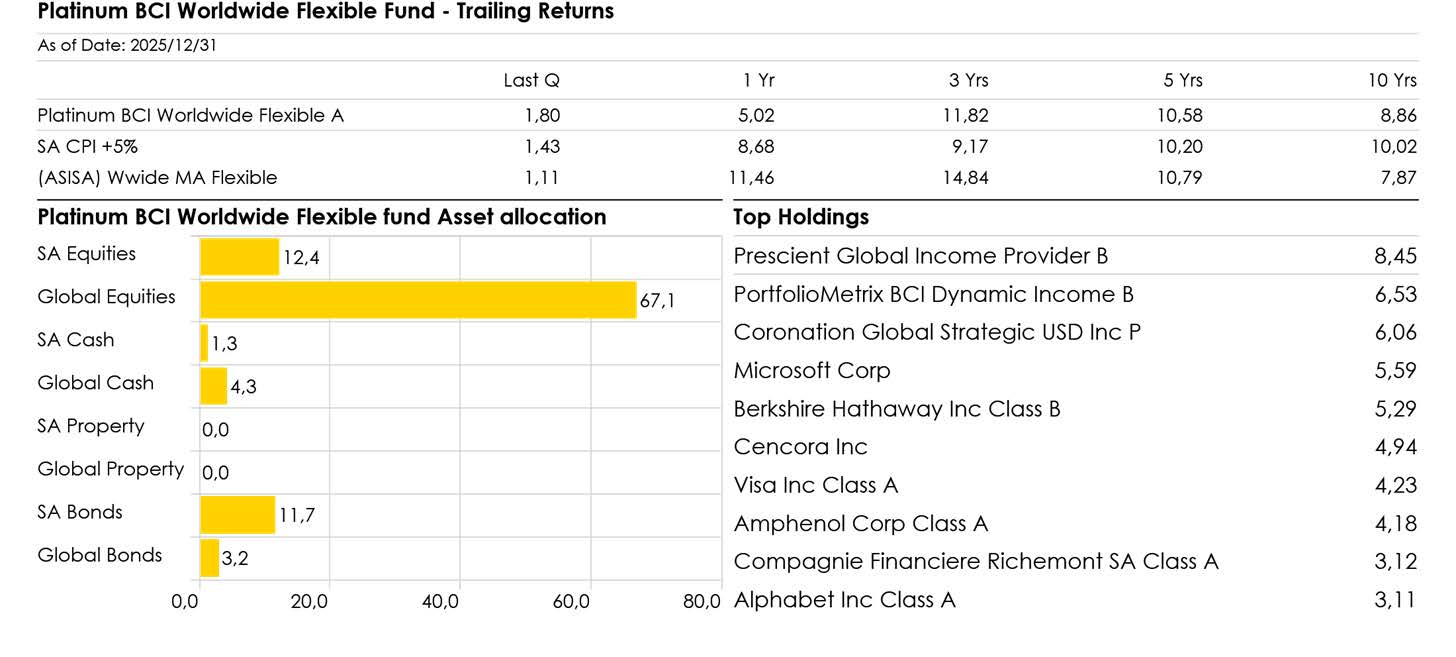
Note: Quarterly performance since inception: Highest 13.17% Lowest –6.68%. Annualised return is weighted average compound growth rate over the period measured. Actual annual figures are available to the investor on request. Source Morningstar as at 31 December 2025.
The Platinum Fund of Funds
In the 4th quarter of 2025, all of the Fund of Funds outperformed their inflation or cash benchmarks:
- The Platinum BCI Balanced Plus FoF delivered a robust 3.85% return, surpassing its SA CPI+5% benchmark by 2.42%.
- The Platinum BCI Balanced FoF achieved 3.57%, exceeding SA CPI+4% by 2.38%.
- The Platinum BCI Income Provider FoF returned 3.07%, outpacing SA CPI+2% by 2.38%.
- The Platinum BCI Defensive Income FoF posted 3.44%, exceeding its STeFI Composite +2% benchmark by 1.18%.
Underlying Manager Performance
Performance across the five underlying equity strategies has been mixed, with standout contributions from our top performers. Amplify has been the strongest contributor, delivering robust returns through positive stock positioning that has effectively captured market opportunities. Truffle and Fairtree have also excelled, posting strong absolute and relative results by capitalizing on the precious metals rally—taking timely profits from gold and platinum miners before rotating capital into deeply undervalued SA Inc opportunities, including banks and insurers who are offering attractive yields. In contrast, Aylett has underperformed due to their avoidance of gold stocks and Naspers/Prosus—two major market drivers—as well as headwinds from holdings like Tsogo Sun and alcohol stocks affected by cyclical and structural pressures.
Our fixed income managers continue to navigate the local bond market with a discipline approach that emphasizes risk management when accessing duration positioning. The short end of the curve remains primarily driven by repo rate expectations, while the long end is heavily influenced by deteriorating debt-to-GDP dynamics—requiring sustained GDP growth for a meaningful long-dated rally. Duration bets are guided by a qualitative assessment of economic momentum combined with quantitative valuation checks. Overall risk has been modestly reduced as 10-year yields have returned to 2021 levels, yet bonds continue to offer compelling value amid local tailwinds: an improved budget outlook, low inflation, better terms of trade (lower oil prices, higher PGMs), and the adoption of 3% inflation target that would anchor expectations and support a new rate-cutting cycle. The long end has steepened while the short end has rallied aggressively. Although the recent sharp bond rally surprised on the upside, our underlying managers are balancing caution with participation—lowering risk while retaining exposure to capture further gains. Inflation linkers are now appearing more attractive at real yields above 5% (e.g., I2033), and internal models still flag bonds as very cheap, though qualitative overlays will test this view going forward.

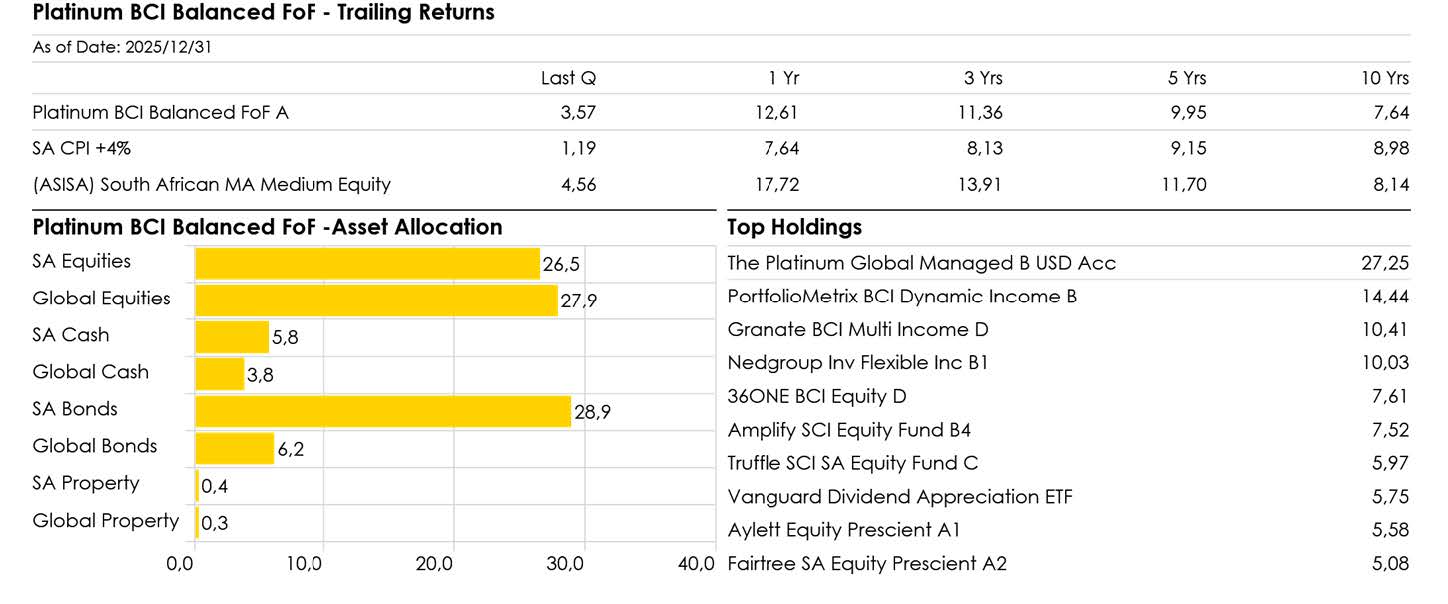
Note: Quarterly performance since inception: Platinum BCI Balanced fund: Annualised return is weighted average compound growth rate over the period measured. Actual annual figures are available to the investor on request. Source Morningstar as at 31.12.2025.
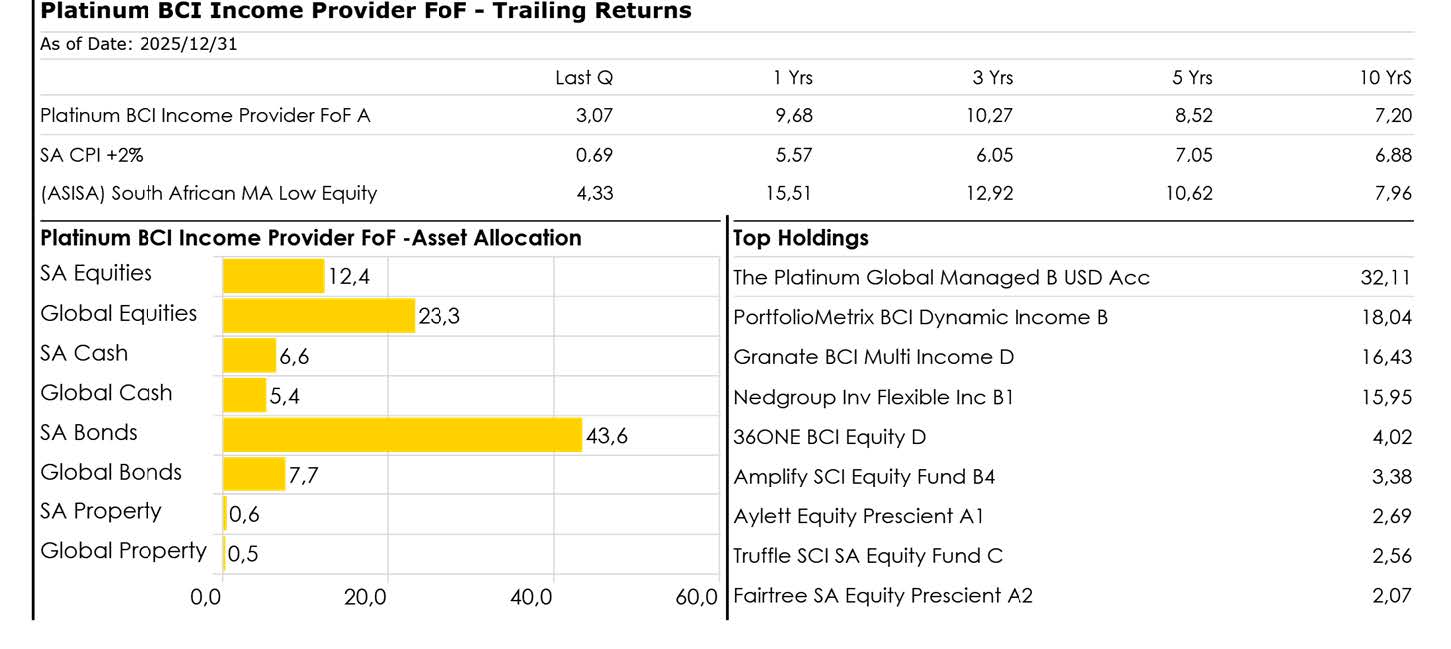

Note: Quarterly performance since inception: Annualised return is weighted average compound growth rate over the period measured. Actual annual figures are available to the investor on request. Source Morningstar as at 31 December 2025.
The Platinum Global Managed fund USD
Performance Overview
The Platinum Global Managed Fund delivered a return of +2.76% for the quarter, comfortably ahead of its benchmark of USD CPI +4%, which was +1.20%. Outperformance was once again driven primarily by strong stock selection within the equity component of the portfolio.
For the full year ending December 2025, the Fund produced a solid return of 12.69% (USD), compared to 7.03% for USD CPI +4%, reinforcing our ability to deliver attractive real returns over time while managing risk prudently.
Key Contributors and Detractors
Positive contributions during the quarter came from Alphabet, Amphenol, Cencora, Amgen, and Cisco Systems, all of which benefited from resilient earnings, strong balance sheets, and favourable long-term industry dynamics.
Detractors included Microsoft, Zoetis, Abbott Laboratories, and Williams-Sonoma. In each case, short-term share-price weakness was driven by valuation compression, sector-specific headwinds, or temporary earnings uncertainty rather than a deterioration in long-term fundamentals. We continue to monitor these holdings closely within our quality and valuation framework.
Portfolio Positioning
At quarter end, the Fund was positioned with 68.5% invested in equities, with the balance allocated to cash, short-dated credit instruments, and US Treasuries. This positioning reflects our disciplined risk-management approach and the Fund’s mandate to deliver consistent real returns rather than maximise equity exposure.
The allocation to cash and defensive assets plays an important role in stabilising portfolio volatility and ensures that the Fund remains well aligned with the risk profiles and capital-preservation objectives of private-client in-vestors. Importantly, the Fund is not managed as a competitor to pure equity funds, but rather as a flexible global solution designed to outperform inflation over time with lower drawdowns.
Outlook and Investment Approach
Ongoing market uncertainties, elevated valuations in certain areas of global equities, and a more selective opportunity set reinforce our prudent stance of maintaining equity exposure at no more than 70%. We remain focused on owning high-quality companies with strong fundamentals, durable cash flows, and sensible balance sheets, while maintaining strict valuation discipline.
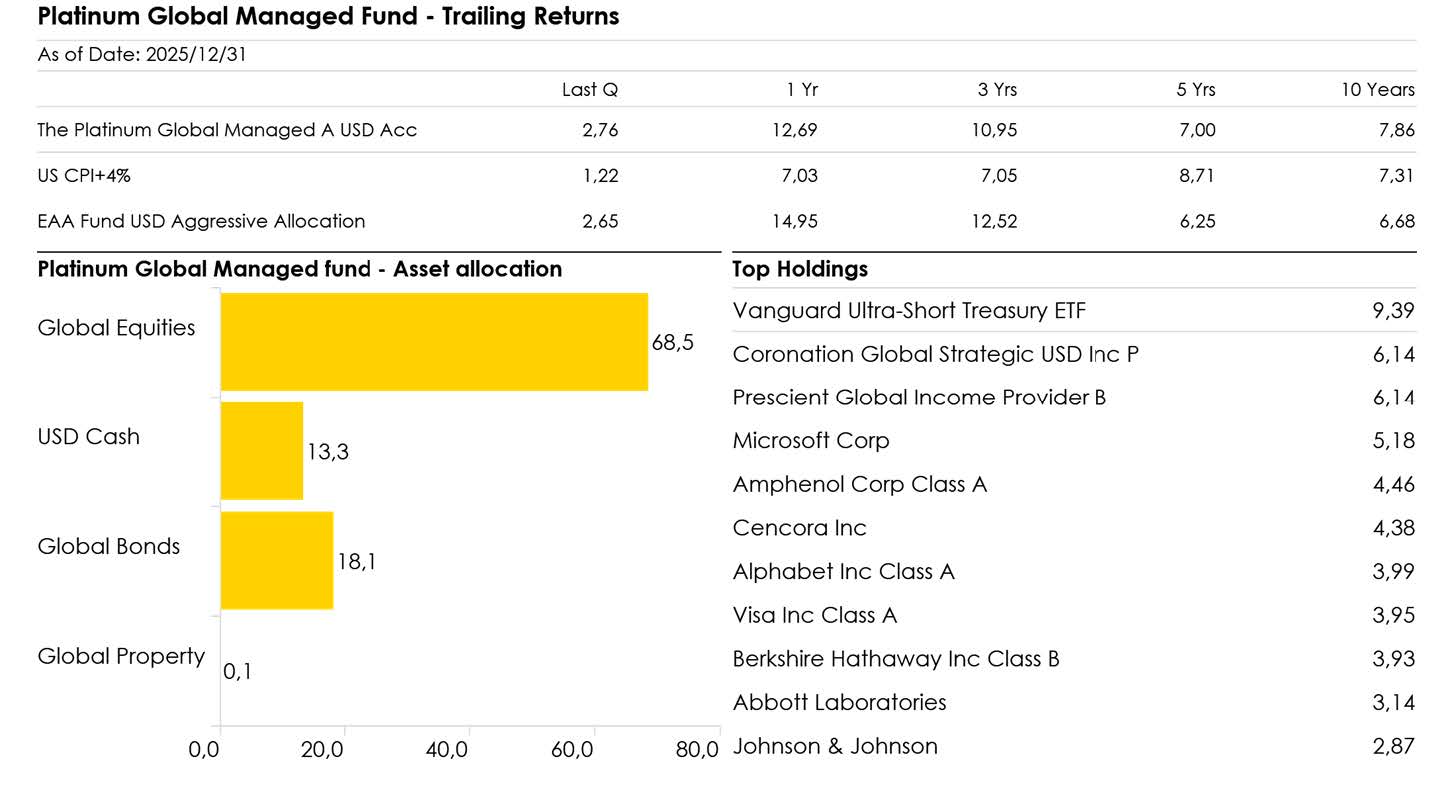
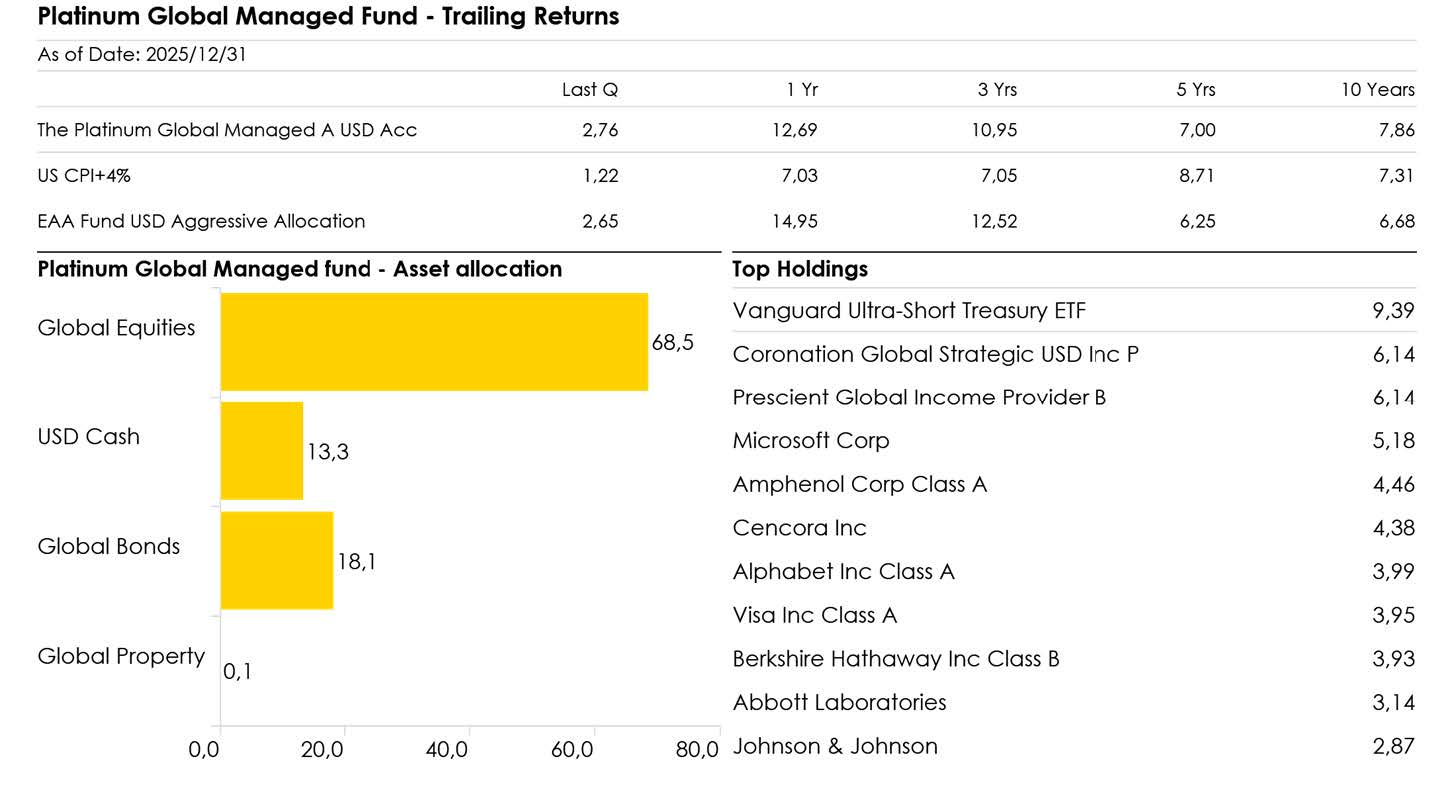
Note: Quarterly performance since inception: Highest: 16.11% Lowest: -8.98%. Annualised return is weighted average compound growth rate over the period measured. All performance figures quoted are sourced from Morningstar. Period ending 30 September 2025.
Company in Focus: Amphenol
Amphenol – A Quiet Compounder at the Heart of Global Connectivity
In a world increasingly defined by data, electrification, and connectivity, some of the most important businesses operate far from the spotlight. Amphenol is one such company – a global industrial champion that plays a critical role in enabling modern technology, yet does so with remarkable consistency, discipline, and resilience.
Who They Are
Founded in 1932 and headquartered in the United States, Amphenol is one of the world’s largest designers and manufacturers of interconnect solutions. The group employs more than 100,000 people globally and operates through a highly decentralised model, with hundreds of operating units serving customers across a wide range of industries.
Amphenol has built its reputation not on flashy consumer brands, but on being a trusted, mission-critical supplier to some of the most demanding end-markets in the world.
What They Do
At its core, Amphenol designs and manufactures:
- Connectors – enabling the transmission of data, power, and signals.
- Sensors – used in industrial, automotive, and environmental applications.
- Interconnnect systems and cable assemblies.
These components may appear small, but they are essential. Without them, modern systems simply do not function.
Amphenol’s products are used across a diverse set of industries, including:
- Automotive (including electric vehicles and advanced driver systems)
- Industrial automation and robotics
- Aerospace and defence
- Mobile devices and communications infrastructure
- Data centres and cloud computing
- Medical and instrumentation equipment
This breadth of exposure provides the company with significant end-market diversification, helping to smooth earnings through economic cycles.
Why We Like Amphenol
From an investment perspective, Amphenol exemplifies many of the characteristics we seek in high-quality global businesses.
1. Mission-Critical Products, Low Customer Substitution Risk
While connectors are a small part of a customer’s total system cost, failure is not an option. This gives Amphenol strong pricing power and deep, long-standing customer relationships.
2. Structural Growth Tailwinds
Long-term trends such as electrification, vehicle complexity, cloud computing, AI-driven data demand, and automation all require more connectivity, not less. Amphenol benefits directly from these secular growth drivers without needing to predict which end-device or platform will ultimately win.
3. Decentralised, Entrepreneurial Culture
Amphenol operates a highly decentralised model, empowering local management teams to respond quickly to customer needs. This has resulted in strong margins, excellent capital discipline, and a long history of successful bolt-on acquisitions.
4. Consistent Free Cash Flow and Returns on Capital
The business has demonstrated an ability to generate robust free cash flow across cycles, reinvesting prudently while returning capital to shareholders. This consistency underpins long-term compounding.
5. Resilience Through Cycles
Thanks to its diversification across customers, industries, and geographies, Amphenol has proven to be far more resilient than many traditional industrial businesses during periods of economic stress.
Conclusion
Amphenol is not a headline-grabbing technology company, but it is a quiet enabler of global progress. Its products sit at the intersection of many of the most powerful long-term trends shaping the global economy.
For us, Amphenol represents exactly the kind of business we favour for client portfolios: a high-quality company, with durable competitive advantages, strong cash generation, and exposure to long-term structural growth – all managed with discipline and consistency. It is these attributes that make Amphenol a compelling long-term holding within a diversified global portfolio.