Global Markets—First Quarter 2026 Review
The first quarter of 2026 was characterised by a noticeable shift in market sentiment, from early optimism to increased uncertainty and volatility. While the year began with expectations of moderating inflation and potential interest rate relief, conditions became more unsettled as the quarter progressed. Heightened geo-political tensions — particularly the escalation in the Middle East and the sharp rise in oil prices — reintroduced inflation concerns and weighed on investor confidence.
Global equity markets experienced a volatile quarter, with gains earlier in the period reversing as bond yields moved higher and risk appetite weakened. Markets increasingly favoured quality, resilient businesses with strong earnings visibility, while more cyclical and highly valued areas came under pressure.
The US dollar strengthened over the quarter, supported by its safe-haven status and a reassessment of interest rate expectations. This created additional headwinds for emerging markets and global assets, particularly in regions more sensitive to currency and capital flow dynamics.
Interest rates remained a key driver of market direction. Expectations for rate cuts were scaled back as inflation risks resurfaced, reinforcing a “higher for longer” outlook. Bond yields moved higher in response, contributing to increased volatility across both equity and fixed income markets.
On the inflation front, earlier signs of moderation were challenged by rising energy prices late in the quarter. This renewed uncertainty around the inflation trajectory and increased the risk that central banks may need to maintain restrictive policy settings for longer than previously anticipated.
Company earnings remained broadly supportive, with continued growth led by large, high-quality businesses, particularly in the US. However, the market became more discerning, with greater focus on margin resilience, input cost pressures and the sustainability of earnings growth in a more uncertain environment.
Despite the pullback in markets, valuations remain elevated relative to long-term averages, particularly in the US. While some excess has been corrected, current levels still leave limited margin for disappointment, reinforcing the importance of valuation discipline.
Overall, the quarter served as a reminder that markets remain highly sensitive to shifts in inflation expectations, interest rate outlooks and geopolitical developments. In this environment, our focus remains firmly on quality businesses, prudent portfolio construction and maintaining a disciplined, long-term investment approach.
South African Economy: First Quarter 2026 Review
South Africa entered 2026 on a more constructive footing than it has enjoyed in years. Four consecutive quarters of positive GDP growth, two consecutive primary budget surpluses, a credit rating upgrade, and inflation at its lowest level in two decades set an encouraging tone.
That optimism was tested as the quarter unfolded. Domestic fundamentals remained broadly supportive, but the outbreak of open conflict between the United States, Israel, and Iran on 28 February introduced a shock that South Africa was ill-equipped to absorb.
Domestic Fundamentals
GDP growth remained modest but positive, with the IMF projecting 1.4% for 2026. Improved electricity reliability and logistics under Operation Vulindlela II supported business activity, while the February Budget earned market applause — for the first time in nearly twenty years, government debt is projected to peak and then gradually decline as a share of GDP. Inflation reached a milestone in February, with headline CPI falling to exactly 3.0% — meeting the SARB’s new point target for the first time. The SARB held the repo rate at 6.75% at both its January and March meetings, pausing an easing cycle that had delivered 150 basis points of cuts since late 2024. The rand and JSE both rallied strongly through February, with the All Share Index reaching record highs, up 9.2% year-to-date.
The Iranian War: A Late-Quarter Shock
The most disruptive event of the quarter — and arguably in several years — was the outbreak of US-Israeli military action against Iran at the end of February. Brent crude surged past $100 a barrel, briefly approaching $120, as traders priced in the risk of supply disruption through the Strait of Hormuz. For South Africa, which imports the vast majority of its crude oil, the impact was immediate. The JSE plunged 9.2% in the first week of March, erasing roughly R2 trillion in market capitalisation, the rand weakened sharply, and analysts projected CPI climbing to 4.5% in April, well outside the SARB’s 3% target. The SARB signalled that rate hikes, not cuts, could follow if conditions deteriorated further.
The Treasury responded by cutting fuel levies by R3 per litre for April, at a cost of approximately R6 billion in foregone revenue. South Africa’s status as a major gold and platinum producer offered a partial offset, as precious metals surged on safe-haven demand. By quarter-end, a US-Iran ceasefire sent oil prices back below $100 and lifted the rand by more than 2%.
Outlook
At the time of writing, a 2-week ceasefire has been agreed upon as negotiations continue to stop the war. Whether the ceasefire holds will define the economic narrative for the rest of 2026. If it does, the inflation spike should prove temporary, and the rate-cutting cycle can resume. If conflict reignites, rate hikes and weaker growth are likely consequences. South Africa’s improved fiscal position and reform momentum provide a solid foundation — but as a small, energy-importing emerging market, it remains acutely exposed to events beyond its borders.
The Psychology of Money: How My Past Shaped My Investment Philosophy
Mel Meltzer, Co-founder, Platinum Portfolios
People often think investment philosophy comes from textbooks, models, or complex theories. In my experi-ence, it doesn’t. It comes from life.
Research in behavioural finance supports this. The way individuals manage money is strongly influenced by their personal background, especially their early experiences with financial security or loss. People who have lived through financial hardship tend to be more cautious. They focus more on protecting capital and are less likely to take speculative risks. Family environment also plays an important role. How money is treated at home shapes how it is treated later in life. These influences are not temporary. They are deeply embedded and tend to stay with a person throughout their career.
There is also evidence that risk tolerance is not entirely learned but partly ingrained. Fund managers bring their own experiences, biases, and instincts into their decision-making. This shows up clearly in returns. More aggressive managers often perform well in strong markets but suffer larger losses when conditions turn. More conservative managers tend to focus on capital preservation and often protect investors better over time. A manager’s personal history is not just background, it is a strong indicator of how they will behave under pressure.
I grew up in a middle-class household. We weren’t poor, but there was never a sense of abundance. Money was always in the background, and to me it often felt like there was not enough of it. When I went to boarding school, I remember being aware that my school account was often in arrears. That stayed with me.
My father was a professional. He worked incredibly hard and took great pride in what he did. He always wanted to do his best. But he was not driven by money. In fact, he largely ignored it. That contrast always intrigued me. I saw discipline and integrity in his work, but very little focus on managing money itself.
Then, when I was young, our family experienced a significant financial loss. It changed everything. It wasn’t just numbers on a page. It was stress, uncertainty, and tension. It affected the whole family in ways that are difficult to describe but impossible to forget. That happened more than 50 years ago, but it has never left me.
It taught me something that has stayed with me throughout my career. Money is not abstract. Loss is not theoretical. It is deeply human.
At university, I studied law, and one of the first things that struck me was a case in the law of delict, Administrator, Natal versus Trust Bank. The court was reluctant to award damages for pure financial loss. The reasoning was that they did not want to open the floodgates. I remember feeling strongly that this missed the point. I had seen firsthand how devastating financial loss can be. It affects families, relationships, stability, and dignity. In many ways, it can be more damaging than physical harm. That case stayed with me.
Early in my career, I had another defining experience. I worked at a firm that did not manage money properly. There was a lack of discipline, a lack of consistency, and, most importantly, a lack of care for clients. The focus was not on protecting and growing clients’ capital, but on short-term profit. It was a clear example of what happens when stewardship fails.
That experience reinforced something I already believed. When you are entrusted with someone else’s money, you are not just managing assets. You are carrying responsibility. That responsibility is absolute.
Around that time, I was introduced to the thinking of Warren Buffett and Charlie Munger. What stood out to me was not just their success, but their simplicity. They spoke about owning businesses rather than trading shares. They spoke about patience, discipline, and, above all, not losing money. I attended my first Berkshire Hathaway shareholders meeting, and that experience had a profound impact on me. It confirmed that you do not need complexity to succeed. You need clarity, discipline, and consistency. I remember feeling excited listening to them. It made sense. It aligned with what I had already come to believe. The goal is not to chase returns. The goal is to preserve capital and allow compounding to do the work overtime.
There is a common belief that fund managers are objective, that with the right models and data you can remove emotion and bias. I don’t believe that. Every fund manager brings their life with them into their work. Their upbringing, their experiences with money, their exposure to loss, and their tolerance for risk all shape how they think and how they act. These factors do not disappear when you sit at your desk. They become part of your decision-making process, especially under pressure.
Some managers are naturally aggressive. They are comfortable taking big risks and can perform well in rising markets. But those same traits can lead to significant losses when markets turn. My experience has led me to a different mindset. I have learned that recovering from losses is far harder than making gains. Capital, once lost, is not easily rebuilt. And most importantly, you do not gamble to get even. I have never been a trader. I do not buy shares based on tips or short-term expectations. Every decision I make is driven by long-term thinking. Getting the big decisions right makes the rest much easier.
Over time, all these experiences have shaped a simple principle that guides everything I do. Capital preservation comes first. Always. This does not mean avoiding risk entirely, but it does mean respecting it. It means thinking like an owner, focusing on downside protection, being willing to do nothing when there is nothing to do, and maintaining discipline when others lose theirs.
If there is one quality that defines a good fund manager, it is not intelligence. It is the ability to live with uncertainty. Markets are unpredictable. There are no guarantees. There is constant pressure to act. But often the right decision is to be patient.
The challenge is not just making decisions. It is making the right decisions while knowing you may be wrong. That requires conviction without arrogance, patience without complacency, and discipline without rigidity. Above all, it requires avoiding greed. This is not a short-term race. It is the tortoise that wins.
Looking back, my journey into fund management was not planned. It developed over time through my family experiences, my early career, and what I observed in others both good and bad. There was no single defining moment. It was a gradual process, shaped by experience and reinforced over time.
In the end, investment philosophy is not just about how you think. It is about who you are. Your history, your successes, your mistakes, and your experiences with loss all become part of your process.
The most important lesson for me is this: The best fund managers are not those who try to be everything to everyone. They are the ones who understand what they are good at, stick to their process, and have the discipline and patience to follow it through. I found that good Fund Managers are inquisitive, have a wide understanding, can invert and understand risk.
Because in this business, it is not just about intellect. It is about attitude.
As Simon Marais, Chief Investment Officer at Allan Gray once said, do not buy the companies you hear about around the braai. The herd often gets it wrong. In investing, doing the opposite of the crowd is often what protects you.
The Platinum BCI Worldwide Flexible Fund
The Platinum BCI Worldwide Flexible Fund experienced a more challenging start to the year and delivered a return of -3.59% (ZAR) for the first quarter of 2026. While the short-term performance was negative, the fund continues to perform well over the long term.
Markets started the year relatively stable but became more volatile as the quarter progressed, particularly due to rising geopolitical tensions and concerns around inflation and interest rates. This led to a pullback in global equity markets toward the end of the quarter.
We did make changes to the portfolio during the quarter, remaining patient and disciplined in our approach. We bought Motorola Solutions and Bidvest. We sold our position in Qualcomm and reduced our South African hedge position. While continuing to focus on high-quality global businesses.
When the Iran Conflict Started, we trimmed some of the holdings that we deemed vulnerable to the shocks of the war. The fund remains conservatively positioned, with flexibility to take advantage of opportunities as they arise.
Performance during the quarter was driven by a small number of companies. The best performing shares included Johnson & Johnson, Walmart, Texas Instruments, Motorola Solutions, PepsiCo, and Colgate-Palmolive, which delivered solid returns in a more uncertain environment.
The main detractors were Microsoft, Richemont, Abbott Laboratories, Visa, Alphabet, and Cencora. Weakness was mainly seen in technology and consumer-related shares, as market sentiment shifted and valuations came under pressure.
Our barbell approach to portfolio construction continues to be effective in helping manage volatility and balance risk across different market conditions.
The quarter was also characterised by increased market uncertainty following developments in the Middle East. Rising oil prices, inflation concerns, and higher bond yields contributed to weaker investor sentiment and increased volatility across markets.
The JSE and the S&P 500 was largely flat over the period, although performance remained concentrated in a small group of companies. This continues to highlight the importance of careful stock selection. The South African rand was relatively stable but slightly weaker overall against the US dollar during the first quarter of 2026.The rand traded in a range of approximately R15.6 to R17.2 per US dollar during the quarter.
We remain comfortable with the current positioning of the fund. Markets are still trading at relatively elevated levels, and we continue to focus on discipline and patience. We believe that periods of volatility will create opportunities to invest in high-quality businesses at more attractive valuations.
Looking ahead, we remain confident that the underlying companies in the portfolio are well positioned to deliver solid long-term returns.
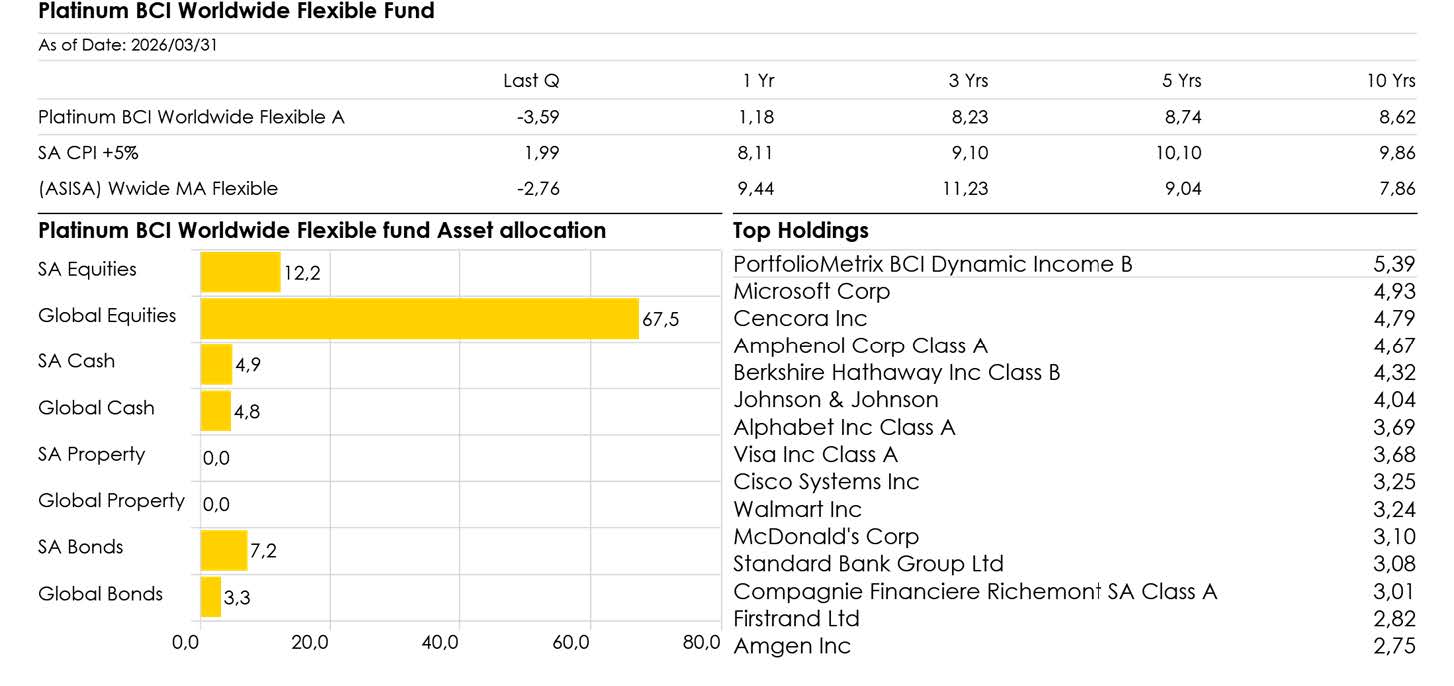
Note: Quarterly performance since inception: Highest 13.17% Lowest -6.68%. Annualised return is weighted average compound growth rate over the period measured. Actual annual figures are available to the investor on request. Source Morningstar as at 31 March 2026.
The Platinum Fund of Funds
In the fourth quarter of 2025, all of the Fund of Funds outperformed their inflation or cash benchmarks. Q1 2026 told a different story – not through any failure of manager selection or asset allocation, but as a direct consequence of the geopolitical shock described in the market commentary.
- The Platinum BCI Balanced Plus FoF returned -1.71% for the quarter, underperforming its SA CPI+5% bench-mark by 3.70%.
- The Platinum BCI Balanced FoF returned -1.17%, underperforming its SA CPI+4% benchmark by 2.92%.
- The Platinum BCI Income Provider FoF returned -0.63%, underperforming its SA CPI+2% benchmark by 2.14%.
- The Platinum BCI Defensive Income FoF returned +0.22%, underperforming its STeFI Composite+2% benchmark by 1.93%.
The quarter began well. SA equity and bond markets rallied strongly through January and February, and all four funds were on track for another solid quarter – until the Iranian conflict reversed those gains almost entirely in the month of March.
The equity-oriented Balanced Plus and Balanced FoFs bore the brunt of the equity and bond market sell-off. Their equity managers all recorded negative returns for the quarter. 36One, which holds a deliberate underweight to precious metals relative to the benchmark, faced additional headwinds as gold surged on safe-haven demand — though their disciplined risk framework and longer-term track record remain intact. The Income Provider FoF also moved into negative territory, though its more conservative allocation provided meaningful cushioning relative to the higher-equity funds.
The standout story of the quarter is the Platinum BCI Defensive Income FoF. Despite the extreme drawdowns in both equity and bond markets described above, it was the only fund in the range to post a positive return. This is precisely what the fund is built to do — and its mandate to avoid negative rolling quarters was upheld under some of the most testing market conditions in recent years.
The Nedgroup Investment Flexible Fund, a core holding, was well-positioned for this environment, having structured a significant portion of the portfolio in floating rate instruments at locked-in yields, providing resilience as rates came under upward pressure. PortfolioMetrix BCI Dynamic Income used the dislocation to actively acquire instruments at attractive levels, positioning the fund constructively for the period ahead.
As we move into Q2 2026, we are closely monitoring the evolving situation in the Middle East and its ongoing effects on oil prices, the rand, inflation, and local asset markets. Where opportunities present themselves — whether in equity valuations or attractive fixed income yields — we will engage them thoughtfully. However, we will not be drawn into reactive trading in the absence of greater certainty.
Prudent, disciplined management of our clients’ capital remains our priority, and we believe that patience in periods of heightened uncertainty is itself a form of active risk management.

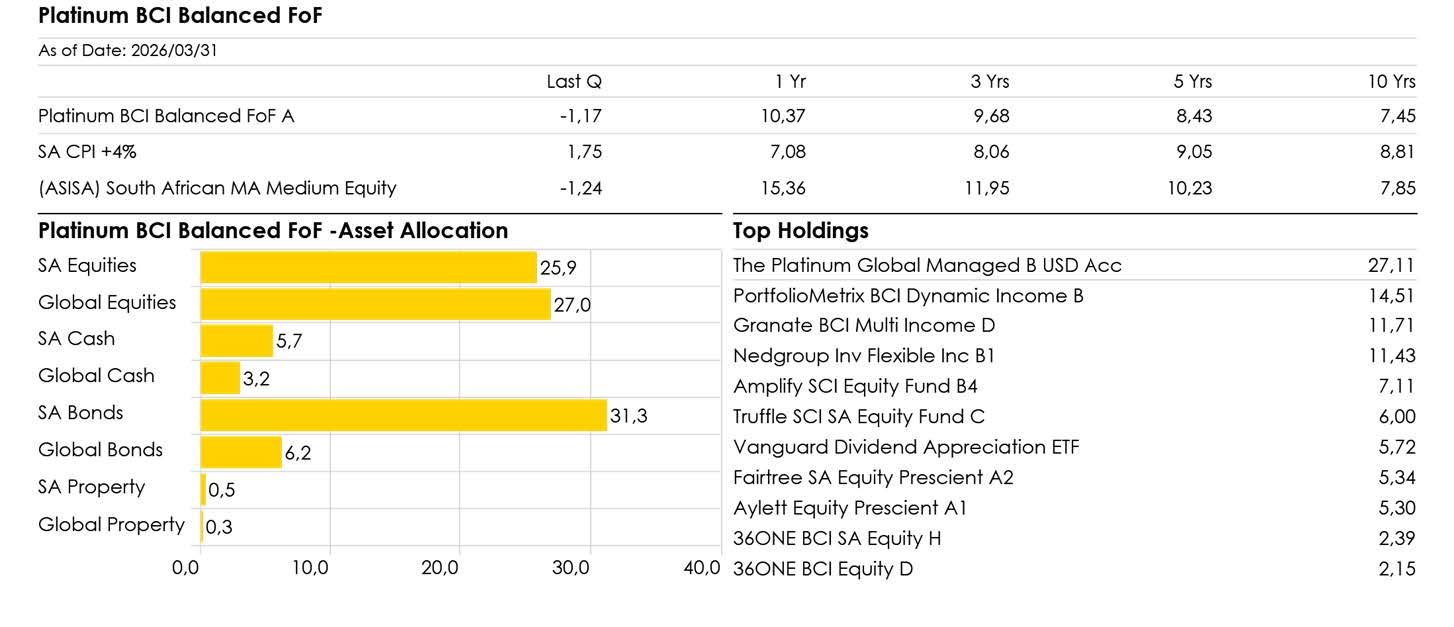
Note: Quarterly performance since inception: Platinum BCI Balanced fund: Annualised return is weighted average compound growth rate over the period measured. Actual annual figures are available to the investor on request. Source Morningstar as at 31.03.2026.
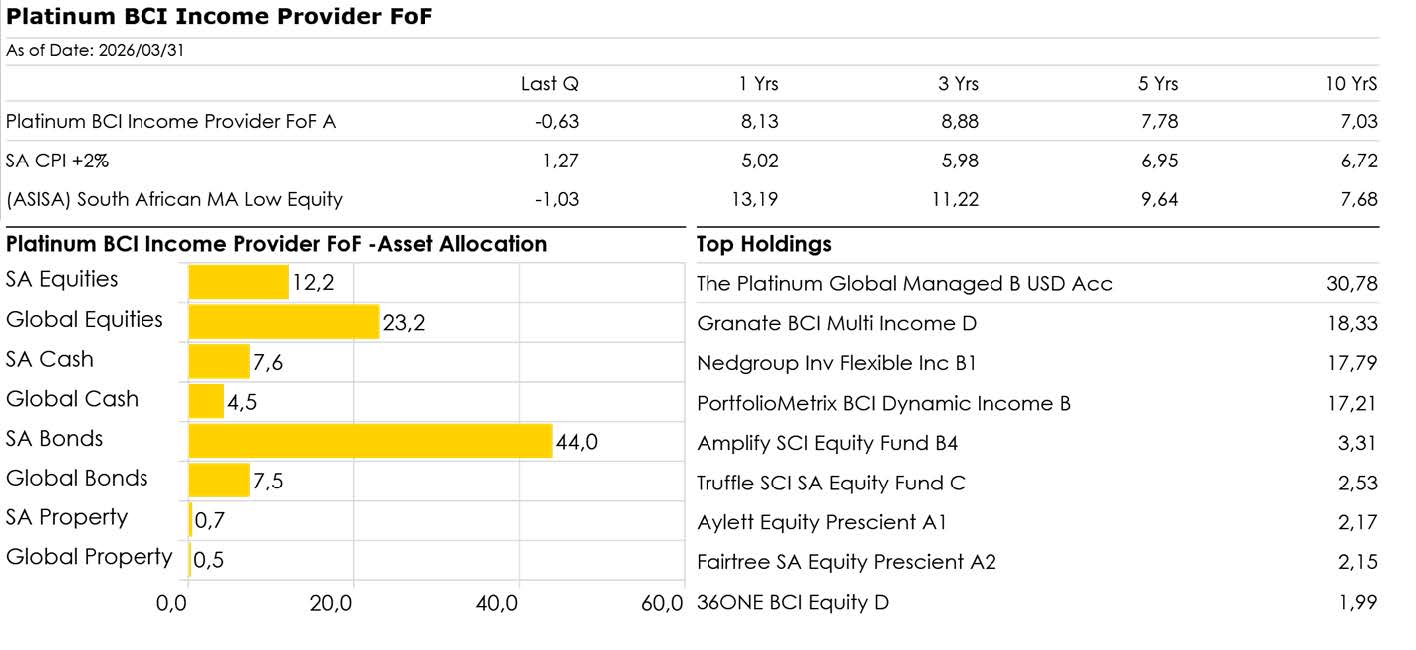
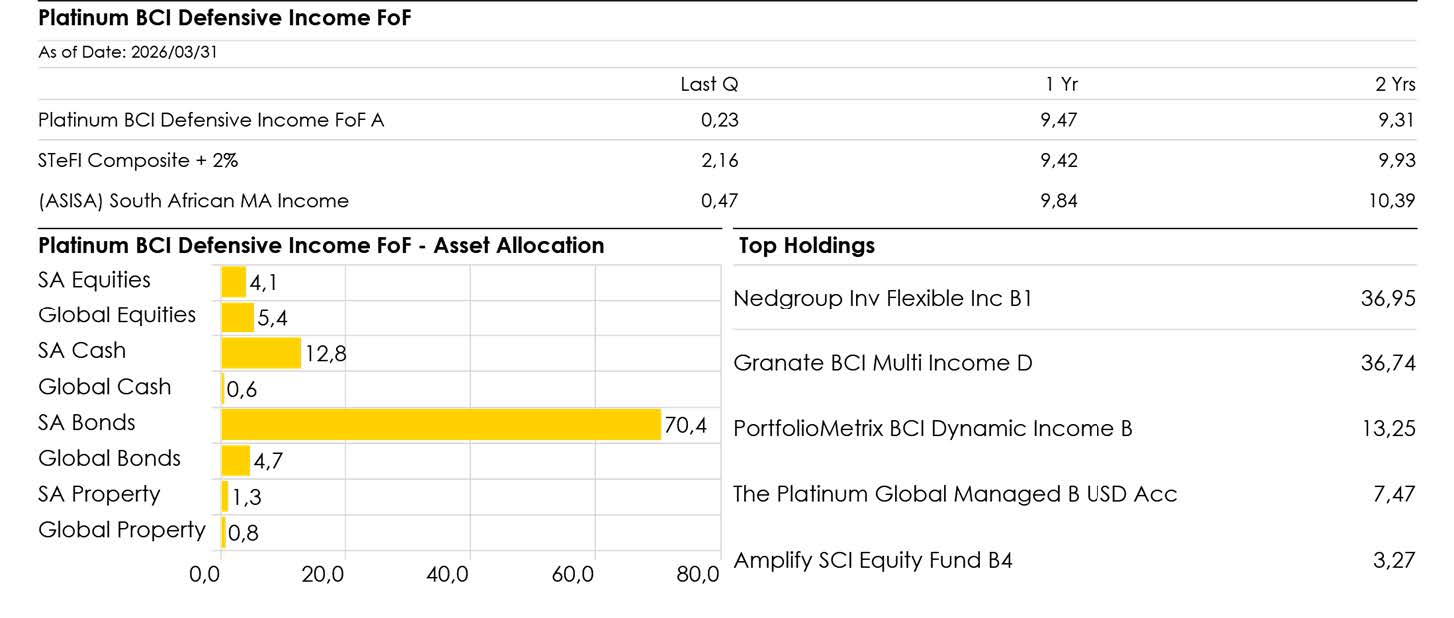
Note: Quarterly performance since inception: Annualised return is weighted average compound growth rate over the period measured. Actual annual figures are available to the investor on request. Source Morningstar as at 31 March 2026.
Platinum Global Managed Fund
Fund Performance
The fund declined by -2.54% for the quarter, outperforming the MSCI World Index (USD), which was down -3.57%. In a challenging and volatile environment, this relative outperformance reflects the resilience of the portfolio and our continued focus on downside risk management.
Portfolio Positioning and Q1 Adjustments
During the quarter, we reduced equity exposure from just over 71% to 67.8%, in line with our cautious stance given elevated market risks and stretched valuations. This was achieved through selectively trimming overweight positions. We also exited Qualcomm and initiated a position in Motorola, reflecting our ongoing focus on quality businesses trading at attractive valuations.
Quarterly Equity Highlights
Positive contributors to performance included Johnson & Johnson, Walmart, Amgen and PepsiCo, all of which demonstrated resilient earnings and defensive characteristics during the period. The main detractors were Microsoft, Visa and Abbott Laboratories, reflecting broader market weakness in certain large-cap and healthcare names.
Market Volatility and Recent Developments
Market volatility increased notably from late February following the escalation of geopolitical tensions, including the US declaration of war on Iran. This drove the oil price above $100 per barrel, raising concerns around inflation, global growth, and policy uncertainty. These developments have reinforced our cautious positioning, particularly given already elevated equity market valuations.
Bond Positioning
The fund’s allocation to short-dated bonds and ultra-short US Treasuries performed as expected, providing stability and capital preservation during periods of equity market stress. This component remains an important buffer within the portfolio.
Looking Ahead
Uncertainty remains elevated, particularly around geopolitical developments and the path of inflation, with ceasefire negotiations still unresolved. We remain mindful of potential risks, including:
- Earnings compression as input costs rise
- Credit market deterioration
- Persistently elevated market valuations
Against this backdrop, we continue to position the portfolio conservatively, focusing on:
- High-quality companies with strong balance sheets
- Consistent and dependable earnings streams
- Disciplined valuation frameworks
While short-term volatility is likely to persist, the underlying businesses in the portfolio remain fundamentally sound. Looking further ahead, a potentially weaker US dollar could provide support to the multinational companies within the portfolio, enhancing earnings translation and contributing to improved performance over time.
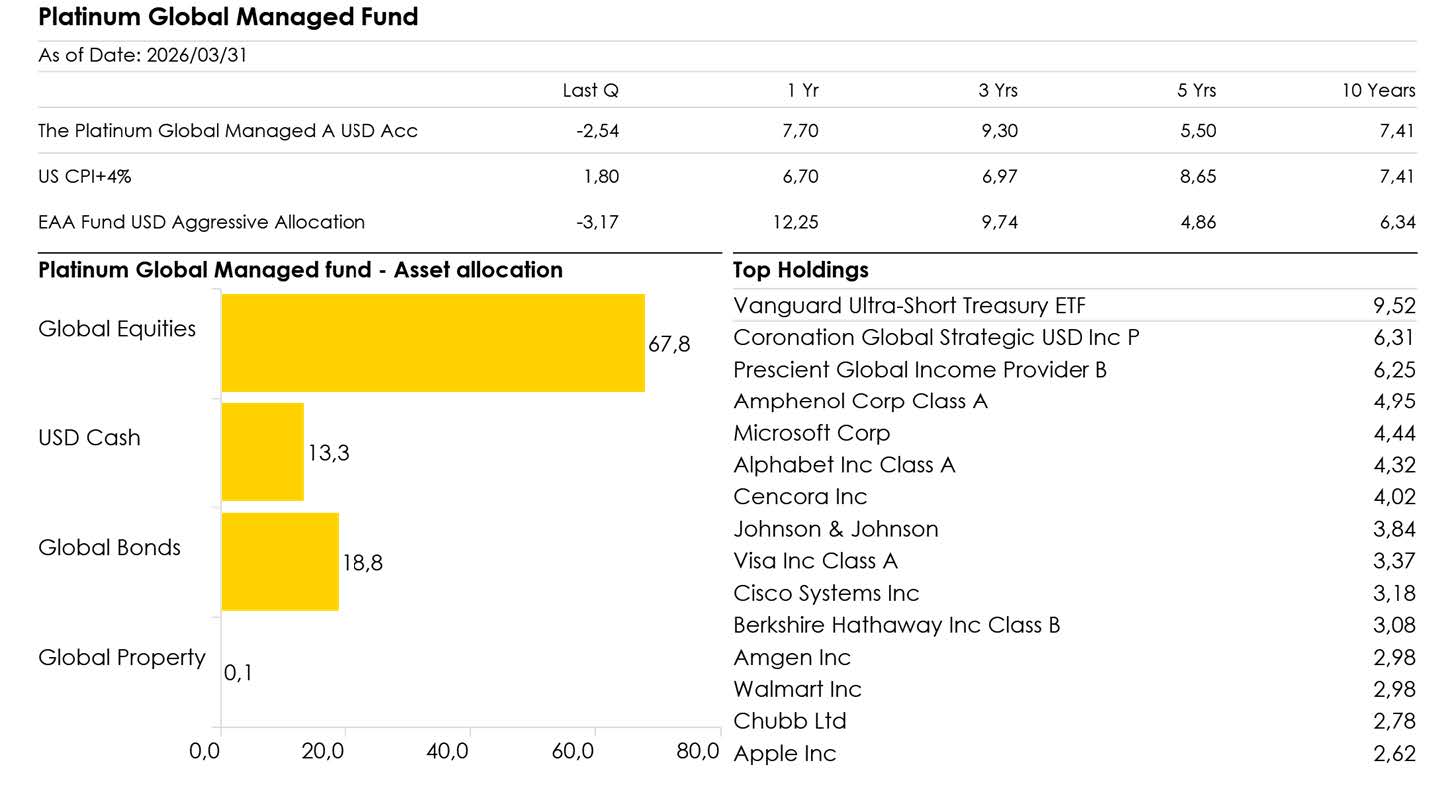
Note: Quarterly performance since inception: Highest: 16.11% Lowest: -8.98%. Annualised return is weighted average compound growth rate over the period measured. All performance figures quoted are sourced from Morningstar. Period ending 31 March 2026.
Stock in Focus: Fortinet
Who Is Fortinet?
Fortinet was founded by two brothers in Sunnyvale, California, in 2000 and has grown from a small firewall startup into one of the world’s most formidable cybersecurity companies. The name itself is derived from the phrase “Fortified Networks,” a fitting description for a business built around protecting the digital infrastructure of the modern world.
At its core, Fortinet develops and sells a broad portfolio of cybersecurity and networking products. Its flagship product, the FortiGate firewall, was launched in 2002 and remains one of the best-known and most widely deployed security appliances worldwide. Fortinet is far more than a firewall company, as it offers over 50 enterprise-grade products spanning network security, endpoint protection, cloud security, threat intelligence, and many others critical to various industries and clients.
Fortinet’s reach is very impressive, with over 900,000 customers around the world, ranging from governments and large enterprises to service providers and small businesses. This makes Fortinet one of the most widely deployed cybersecurity platforms in the industry. Its interconnected platform is a key point of differentiation, allowing all Fortinet products, along with over 500 third-party solutions, to communicate and operate as a single, unified defence system. Rather than stitching together products from many different vendors, customers get a coherent, end-to-end security architecture from one provider.
Why Cybersecurity, and Why Now?
We live in an increasingly digital world. Businesses, hospitals, banks, power grids, governments, and individuals now rely on connected technology for virtually everything they do. And wherever there is connectivity, there is vulnerability.
Cybercrime is one of the fastest-growing threats of our era. Cybersecurity Ventures estimates that cyber-crime will cost the world $10.5 trillion USD in 2025 alone, up from $3 trillion just a decade ago. To put that in perspective, if cybercrime were a country, it would be the third-largest economy on earth, behind only the United States and China. Ransomware, phishing, data breaches, and state-sponsored attacks are not slowing down. They are accelerating.
The cybersecurity market is responding in kind, projected to grow from approximately $227 billion in 2025 to over $350 billion by 2030. Spending on cybersecurity will only increase as the digital attack surface expands with cloud adoption, the proliferation of IoT devices, AI-powered threats, and digital transformation across every industry. This is not a niche or speculative theme; it is structural and enduring. Cyberattacks will only increase as the world becomes more technological, and therefore companies and individuals need robust protection. This shows the need for a world-class cybersecurity company in our portfolio.
The Competitive Advantage: Custom Silicon
Fortinet’s most overlooked and most powerful advantage is its ability to design its own chips. Fortinet is the only pure-play cybersecurity company in the world to develop proprietary Application-Specific Integrated Circuits (ASICs), purpose-built for security tasks and then manufactured by third-party semiconductor foundries. The result is hardware that outperforms competitors’ general-purpose CPU-based products by 17 to 32 times on key security functions, while consuming 88% less power. Better performance, lower cost, and superior energy efficiency all in one.
The strategy also delivers a significant supply chain advantage. By consolidating multiple networking and security functions onto a single chip and ordering millions of units at a time, Fortinet gains pricing leverage and resilience that competitors simply cannot match. It is a moat built over two decades, and one that grows harder to replicate every year.
Why We Own It
Fortinet sits squarely at the intersection of two of the most powerful long-term trends in the global economy: the relentless digitisation of the world, and the equally relentless rise of cyber threats that digitisation creates. That intersection is, in our view, one of the most attractive places to be as a long-term investor.
What makes Fortinet particularly compelling is not that we are simply owning a generic cybersecurity company, but the quality of its competitive position. The custom silicon strategy is a genuine, durable, and hard-to-replicate moat. Fortinet has also demonstrated a commitment to innovation that extends well beyond its core hardware. The company is rapidly expanding its AI-powered threat intelligence capabilities through FortiGuard Labs, its elite research and threat detection arm.
As the world becomes more connected, the need for what Fortinet provides will only grow. In our view, this is not a short-term opportunity, but a long-term structural trend. Fortinet’s broad product portfolio, integrated platform, and unique custom-silicon advantage position it well to remain an important cybersecurity leader for many years to come.