Trump’s New Tariffs: What They Mean for Markets and Investors
On the 2nd of April 2025, President Donald Trump introduced sweeping new tariffs on a range of imports, marking a sharp escalation in his “America First” trade policy. These tariffs, aimed at reducing trade deficits and bringing manufacturing back onshore, have already triggered retaliation from key trading partners like China. Market volatility has surged in response, and the investment community is watching closely.
Perspectives from Leading Thinkers
To help navigate the implications of this policy shift, we’ve reviewed the views of some of the investment industry’s most respected voices. The following perspectives from Howard Marks, David Rosenberg, and Ray Dalio offer valuable insights into how these tariffs could reshape the economic and investment landscape.
Howard Marks: A Shift Toward Isolationism
Howard Marks, co-founder of Oaktree Capital, warned that we are witnessing a significant departure from decades of globalization. “We’ve gone from free trade and world trade and globalization to this system, which implies significant restrictions on trade in every direction and a step toward isolation for the United States,” he said. For Marks, the uncertainty created by these changes is the biggest concern: “The snow globe has been shaken,” he noted, with implications that may take time to fully understand. In his view, while some asset classes remain reasonably valued, the rising unpredictability of macroeconomic policy calls for caution and resilience in portfolio construction.
David Rosenberg: A Hidden Tax on Consumers
Economist David Rosenberg has taken a more critical view. He argues that tariffs function as a regressive tax on American consumers, leading to higher prices and reduced disposable income. In his recent analysis, Rosenberg warned that these policies could backfire, raising input costs for U.S. companies and prompting job losses in export-sensitive sectors. “Investors are now waking up to the fact that these aren’t just negotiating tactics,” he said. “They’re part of a broader protectionist agenda.” He has suggested that such moves increase the risk of a policy-driven recession and believes investors should remain defensive.
Ray Dalio: Strategic Positioning in an Era of Conflict
Bridgewater’s Ray Dalio took a broader geopolitical view. He framed the tariffs not simply as economic tools but as strategic levers in a time of intensifying global power rivalries. “Tariffs and other protectionist measures may reduce economic efficiency and increase inflation, but they’re a necessary part of preparing for an era of greater international conflict,” Dalio said. He believes investors need to think beyond traditional business cycles and consider the longer arc of geopolitical and monetary shifts. Dalio anticipates a move toward fiscal dominance, more active government intervention, and continued market fragility as the old global order breaks down.
Market Reaction: Volatility Returns
Markets reacted swiftly to the announcement of the tariffs and the ensuing retaliation from China. In the days that followed, the Dow Jones dropped over 2,200 points, wiping out $6.4 trillion in value. Equity investors fled to safety, while bond yields declined. This reaction underscores just how sensitive markets are to geopolitical shifts and policy uncertainty. For advisors and investors, the key message is clear: volatility is back.
Our View at Platinum Portfolios: Focus on Quality, Stay Invested
While the headlines may feel unnerving, we remain committed to our core investment principles. At Platinum Portfolios, we believe the key to long-term success lies in owning high-quality multi-national businesses with durable competitive advantages, strong balance sheets, and the ability to navigate through macroeconomic noise.
Tariffs and policy shifts are a reminder that the investment environment is constantly evolving—but that’s precisely why discipline and consistency matter more than ever. We don’t invest based on headlines. We invest based on fundamentals.
Periods of volatility often give rise to opportunity. Market overreactions can allow us to buy exceptional companies at better prices. Rather than trying to time short-term swings, we stay focused on what we can control: identifying value, managing risk, and helping our clients stay the course. In times of uncertainty, staying invested in a diversified portfolio of quality assets is not just a prudent strategy—it’s the best way to compound wealth over time.
Local Market Commentary
In the first quarter of 2025, South Africa’s stock and bond markets faced significant turbulence, driven by political instability within the Government of National Unity (GNU) and external pressures from U.S. trade policies. Regardless of this, the JSE All Share index managed to end the quarter up over 5%. The Rand benefited from the US Dollar’s weakness, despite exacerbating economic challenges in a country already grappling with low growth, projected at 1.5% for 2025 by the IMF.
DA’s Budget Rebellion: Locally, the pivotal event was the Democratic Alliance (DA), amongst others, voting against the 2025 budget. Passed narrowly at 194 to 182 votes, the budget proposed a VAT hike from 15% to 16% over two years. This fractured the ANC-DA coalition, raising fears of the GNU’s collapse. The DA’s subsequent legal challenge further destabilised the coalition, eroding investor confidence and triggering market sell-offs, particularly in banking and retail sectors. At the time of writing, the ANC had hit the reset button on the GNU, giving itself 5 days to negotiate with all political parties. The outcome of which will have significant impacts on local markets over the medium term.
Trump Imposes Tariffs: Further complicating matters, U.S. President Donald Trump introduced a 30% tariff on South African exports effective April 9, citing an $8.8 billion trade deficit. Affecting over $2 billion in goods, including vehicles and citrus, the move effectively ended AGOA benefits. Trump claimed South African tariffs reached 60%, though data suggests an average of 7.5%, hinting at political motives. Trade Minister Parks Tau opted for diplomacy over retaliation, seeking negotiations with the U.S. to mitigate impacts on industries like automotive and agriculture.
Uncertain Outlook: South Africa faces mounting challenges. The GNU’s stability hangs in the balance—its potential collapse could derail economic progress. Simultaneously, the U.S. tariffs threaten export-driven sectors, testing the government’s diplomatic efforts. While the Rand and JSE have shown resilience over the quarter, rising yields and political uncertainty signal risks ahead. Should the DA’s legal challenge succeed, or coalition talks falter, recovery prospects could dim. Tau’s negotiations with the U.S. will be crucial as markets brace for further developments in this high-stakes environment.
Investing in extreme market conditions led by political agendas will test one’s resolve. At Platinum Portfolios, we understand the value of resilience. Long-term strategies, focusing on sound risk management, will weather these disruptions and reward those who stay invested through the volatility.
Insights
The Maintenance Race: What a Solo Sailing Competition Reveals About Successful Fund Management
In 1968, nine men set sail alone into the most dangerous seas on Earth, chasing a dream no one had achieved before: to be the first person to sail solo, non-stop around the world. The Sunday Times Golden Globe Race promised glory and cash to the winner, but it delivered something far more enduring – a story about discipline, preparation, and the high cost of neglect.
Three sailors became legends – not just for how far they got, but for how they sailed.
Robin Knox-Johnston, only 29, didn’t have the fastest or most modern boat. What he had was something far more powerful: an obsessive commitment to maintenance. He knew his vessel inside and out. He had tools and spares for everything, from bilge pumps to sailcloth needles. When leaks appeared, he dove beneath the boat in shark-infested waters and made repairs by hand. When the mast almost tore loose in a storm, he calmly rebuilt it. He didn’t panic. He just kept fixing – every day, every mile, until he crossed the finish line after 312 days at sea.
Donald Crowhurst, on the other hand, had innovation, ambition – and very little else. His sleek trimaran was fast but unfinished. Electrical systems weren’t hooked up, gear was missing, and basic tools were left ashore. He had no margin for error. As problems mounted, he began faking his location reports. While the world believed he was rounding Cape Horn, he was adrift in the Atlantic, trapped in a web of lies. After seven months alone, his mind fractured. He left behind pages of frantic philosophical musings and then stepped off his boat into the sea. His empty vessel was found days later.
Bernard Moitessier was perhaps the most capable of them all – a quiet master who had spent years at sea before the race. His boat was rugged, simple, and ruthlessly well-prepared. He designed it so everything could be repaired with minimal effort and carried spares for everything he couldn’t improvise. But halfway through the race, approaching victory, he turned his back on the fame awaiting him. He simply kept sailing – on toward the peace of the Pacific, saying only, “I am continuing nonstop because I am happy at sea, and perhaps to save my soul.”
These three stories are often told as a test of endurance – but at their core, they are a study in maintenance styles.
And in that, they hold a profound lesson for fund managers and investors.
Success in investment isn’t about flashy innovation or blind confidence. It’s not even about speed. It’s about what you do every single day when the market is calm, and what you’re prepared to do when the storm hits.
- Knox-Johnston is the model of a disciplined, process-driven fund manager. He didn’t chase performance; he stuck to the basics, kept his systems functional, and endured the entire cycle. Like a well-run fund, he focused on the long-term, managing risk with every decision.
- Crowhurst is the cautionary tale – the over-leveraged, under-prepared manager who bets everything on theory and speed, without the foundation to back it up. His failure wasn’t due to lack of intelligence; it was due to a lack of process and risk control.
Moitessier shows the value of simplicity and focus. He cut out everything unnecessary. With less complexity, there was less to maintain — and more energy for what mattered. He reminds us that successful investing doesn’t require bells and whistles, just clarity, consistency, and purpose.
At sea or in the markets, there is no shortcut around discipline.
Great sailors and great fund managers are quietly obsessive about maintenance – of their boats, their processes, their portfolios, and their thinking. They understand that breakdowns don’t happen all at once – they build silently, invisibly, when things are good. Which is exactly when the diligent are working hardest.
As Knox-Johnston himself wrote after weeks alone in a leaking, storm-battered boat: “Doing maintenance cures depression.”
In fund management, it does even more — it keeps your capital alive, afloat, and heading home.
Report back on our funds
The Platinum BCI Worldwide Flexible fund
The Fund delivered a positive return in the first quarter of 2025. Our cautious approach, especially given the high prices in global markets, helped us navigate what turned out to be a very uncertain and volatile period.
The return of Donald Trump as US president has led to several sudden changes in trade, energy, and global politics. This has created more unpredictability, particularly in US markets. Despite this, our fund continues to perform well over time — it is currently the second-best performing fund in its category over the last 15 years. We believe we are well positioned to manage whatever lies ahead.
Global Markets – A Volatile Start to 2025
At the beginning of the year, the outlook for global markets was positive — the US economy was strong, inflation was under control, and there was hope for more global stability. but things changed quickly. President Trump’s new policies created a lot of concern. There were worries about trade wars, rising inflation, and slower economic growth. This led to a sharp drop in US stock markets in March.
In contrast, markets outside the US did much better: Europe gained strength thanks to increased government spending, especially in Germany. China saw a rebound in its tech sector after launching a new local artificial intelligence platform. Overall, global stock markets fell slightly — mainly because of the decline in the US.
Safe-Haven Assets Rise
With all the uncertainty, many investors moved their money into safer assets: Gold hit a record high of $3,100 per ounce. US government bonds also performed well. Global bonds ended the quarter with positive returns.
Fund Activity – What We Did This Quarter
We slightly increased our investment in shares during the quarter (by 2.6%). This was mainly due to: Buying Meta and Alphabet (Google’s parent company) at lower prices – these are new additions to the fund.
Top Performers This Quarter
Some of the fund’s best-performing stocks included: Philip Morris (top performer), Amgen, Berkshire Hathaway, Visa.
We expect markets to stay volatile in the months ahead, especially as the world adjusts to changing US policies and ongoing trade tensions. But volatility also brings opportunity. Sometimes, great companies get caught up in market sell-offs. That gives us a chance to buy quality businesses at better prices, which is exactly what we aim to do.
We remain committed to growing and protecting your wealth through careful research, discipline, and a focus on long-term value.
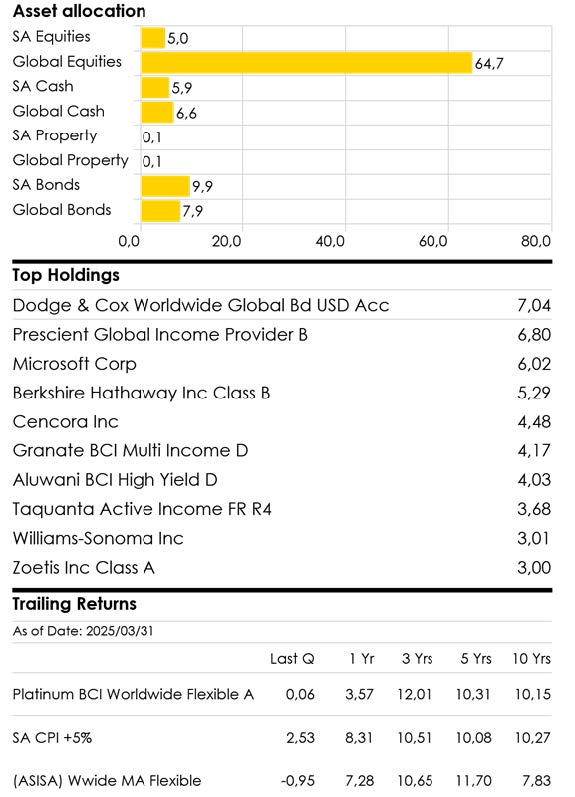
Note: Quarterly performance since inception: Highest 13.17% Lowest –6.68%. Annualised return is weighted average compound growth rate over the period measured. Actual annual figures are available to the investor on request. Source Morningstar as at 31 March 2025.
The Platinum BCI Balanced Fund of Funds and Platinum BCI Income Provider Fund of Funds
Coming into 2025, our funds were positioned for a bearish outlook on South Africa. While we maintained a healthy overall allocation to equities, we were cautious about the local economy’s growth prospects, leading to an underweight position in South African equities. This stance extended to an overweight allocation to offshore markets and an underweight position in the Rand.
Unfortunately, by late February and into March, concerns over the strength of the US economy and rising long-term inflation emerged, triggering a tumble in US markets. President Trump’s reaffirmation of tariffs on Canada, Mexico, and China further escalated trade tensions, weakening the US Dollar. Despite these challenges, our funds protected investors from significant drawdowns and delivered positive returns over the quarter.
April began with Trump’s reciprocal tariff announcement on “Liberation Day”, sparking a sharp decline in offshore markets reminiscent of the COVID-era downturns and sending systemic shocks worldwide. Bond yields—both local and offshore—surged, reflecting uncertainty over geopolitical tensions and the permanence of these tariffs. In addition, public disputes among GNU members drove the Rand to record highs against the British Pound.
Our funds have remained resilient amid steep declines in equity and bond markets, buoyed by our quality-focused stock and manager selection and a cautious approach to bonds. While we are always vigilant for buying opportunities in these extreme conditions, we believe the prudent course is to prioritise risk management and downside protection over chasing returns at this time.
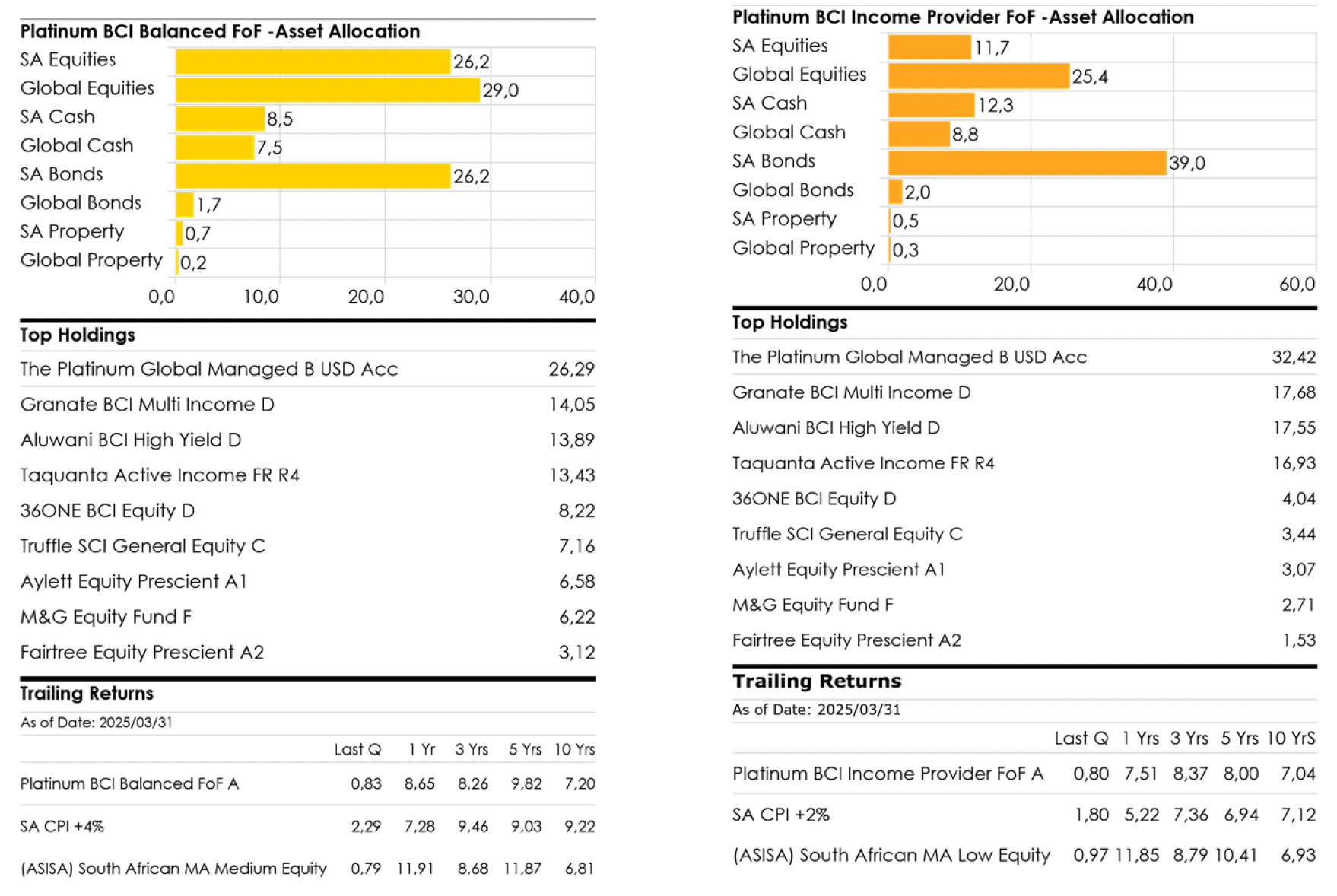
Note: Quarterly performance since inception: Platinum BCI Balanced fund: Highest 8.62% Lowest -3.90%. Platinum BCI Income Provider fund: Highest 5.28% Lowest -1.84%. Annualised return is weighted average compound growth rate over the period measured. Actual annual figures are available to the investor on request. Source Morningstar as at 31 March 2025.
Platinum Defensive Income Fund of Funds
Amid the current market turmoil, it is reassuring to see our Defensive Income Fund of Funds continue to deliver steady, absolute returns for investors, upholding its record of no negative calendar months since inception.
Our underlying managers have posted solid returns over this period. After discussions with them, they echo our cautious outlook on the local economy and have adjusted their fund positioning accordingly, often opting to hold higher-than-usual cash levels as they await attractive entry points into debt instruments. Recent attention on South Africa—particularly from the US administration and elevated global market risks have created opportunities in South African government and corporate bonds listed offshore in hard currencies, as spreads widen.
Our tactical allocation to offshore equities detracted from performance this quarter, with Rand appreciation offsetting gains in the underlying holdings. Entering April, this trend should reverse, potentially boosting returns for the strategy.

Annualised return is weighted average compound growth rate over the period measured. Actual annual figures are available to the investor on request. Source Morningstar as at 31 March 2025.
The Platinum Global Managed Fund USD
The first quarter of 2025 presented a complex and often volatile investment environment, but the Platinum Global Man-aged Fund held steady, reflecting our long-term philosophy and disciplined portfolio construction. While broader equity markets faced headwinds, the fund’s exposure to quality global businesses supported resilient performance. The S&P 500 declined by -4.6% during the quarter, whereas our fund delivered a positive return of 1.97%, underscoring the strength of our portfolio in a challenging market. The MSCI World USD Index also declined by -2.14%.
Market Context
Q1 was marked by escalating trade tensions, tighter financial conditions, and geopolitical uncertainty. In February, Pres-ident Donald Trump reignited tariff disputes, announcing 25% duties on imports from Mexico and Canada and 10% on Chinese goods. Although temporarily paused for negotiations, the move spooked markets and reignited fears of a trade war.
At the same time, persistently high U.S. inflation delayed anticipated Fed rate cuts, while weak European growth and lingering concerns around China’s property sector further weighed on sentiment. Despite the volatility, U.S. corporates – especially in healthcare and consumer staples, where our fund is well-represented – delivered stronger-than-expected earnings.
Fund Positioning and Performance Drivers
The fund’s Q1 performance was driven by several key holdings delivering double-digit gains. Visa, Johnson & Johnson, Berkshire Hathaway, Abbott Laboratories, AbbVie, Amgen, Cencora, and Philip Morris each returned over 10% during the quarter.
This broad-based strength reflects our focus on high-quality, globally diversified businesses across sectors. These companies demonstrated robust fundamentals, pricing power, and defensive characteristics that helped them outperform in a volatile market.
The healthcare sector was particularly strong, supported by consistent demand, innovation pipelines, and investor preference for stability amid uncertainty. Meanwhile, Berkshire Hathaway and Visa benefited from resilient consumer spending and disciplined capital management.
Our strategic blend of sectoral diversity, quality bias, and disciplined positioning contributed significantly to the fund’s +1.97% return, achieved while both the S&P 500 and MSCI World Index declined.
We made a few adjustments during the quarter, initiating new positions in Alphabet Inc. Class C and Meta Platforms — both attractively valued, dominant in digital advertising, and gaining momentum in AI and cloud infrastructure. We also increased our allocation to Amphenol, a high-quality compounder capitalizing on long-term trends in connectivity and electronics. Positions in Comcast and UPS were exited, with capital redeployed into areas offering stronger long-term growth prospects.
Looking ahead, markets may remain choppy amid rising tariff pressures, shifting rate expectations, and geopolitical uncertainty. Despite these headwinds, we believe the portfolio is well-positioned with high-quality businesses that can navigate volatility and continue to compound value over time.
We’re holding a meaningful cash allocation and will continue to look for opportunities that align with our long-term approach – patience, discipline, and a focus on long-term value.
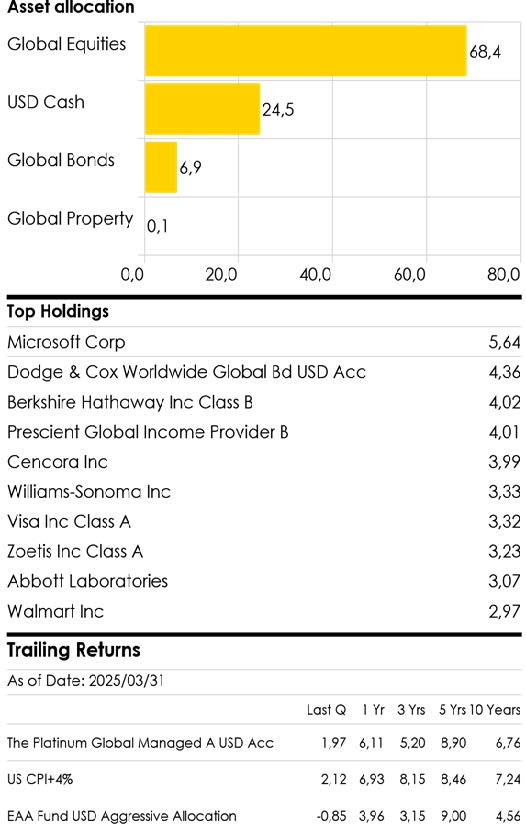
Note: Quarterly performance since inception: Highest: 16.11% Lowest: -8.98%. Annualised return is weighted average compound growth rate over the period measured. Actual annual figures are available to the investor on request. All performance figures quoted are sourced from Morningstar. Period ending 31 March 2025.
New Fund Launch: Platinum BCI Balanced Plus Fund of Funds
At Platinum Portfolios, we’ve always believed in building long-term wealth through disciplined, risk-conscious investing. As we mark our 25th year in business, we’re proud to introduce a new addition to our fund range: the Platinum BCI Balanced Plus Fund of Funds.
This fund offers investors a well-diversified solution aimed at delivering superior, steady, inflation-beating returns with a benchmark of achieving 5% above inflation.
Meeting the Needs of Retirement Savers that are looking for a high growth, long-term solution
For many investors, the challenge isn’t just saving — it’s ensuring that their money grows meaningfully and keeps pace with the rising cost of living. The Balanced Plus Fund addresses this by targeting a return of 5% above South African CPI on an annualised basis.
This real return focus is especially relevant in the current economic climate, where inflation continues to eat into purchasing power. By aiming to outperform inflation consistently, the fund helps investors preserve and grow their wealth over the long term.
Diversification at Its Core
The fund follows a multi-asset, multi-region approach, investing across equities, bonds, listed property, and cash – both locally and globally. While South Africa remains a core component, the fund also seeks opportunities beyond our borders, adding valuable diversification and reducing reliance on any single market or sector.
This approach helps smooth out volatility and enhance returns – a critical consideration for those nearing or already in retirement.
Built on 25 Years of Investment Expertise
The Platinum BCI Balanced Plus Fund of Funds is grounded in the same investment philosophy that has guided our business for over two decades: a focus on quality, a commitment to research-driven decision-making, and an unwavering dedication to managing risk.
Our team applies a rigorous, forward-looking investment process that blends fundamental analysis with real-time market insights. Portfolios are actively managed, with asset allocations adjusted as needed to ensure the fund achieves its CPI +5 target with the minimum amount of risk.
Completing the Picture
With the launch of the Balanced Plus Fund, we now offer a fully rounded suite of solutions to meet the varying needs of our clients. Whether investors are just starting out, building wealth, or preparing for retirement, they can find a fund within the Platinum Portfolios range that aligns with their goals.
This new fund is more than just an investment option – it’s a cornerstone for retirement planning, backed by a 25-year track record of integrity, performance, and client-first thinking.
The fund will launch on 1st June 2025.
Stock in Focus: Philip Morris International
A Quality Compounder with Low Tariff Exposure
At Platinum Portfolios, we’re always on the lookout for high-quality businesses that can weather uncertainty, compound capital over time, and deliver predictable returns for our clients. One company that continues to stand out is Philip Morris International (PMI). Despite operating in a complex industry, PMI has several attributes that make it particularly resilient – especially in today’s environment of geopolitical tension, shifting trade dynamics, and economic noise.
A Global Business, But Not a Global Trade Risk
One of PMI’s most underappreciated strengths is its low exposure to tariffs. Unlike many global consumer companies that rely heavily on cross-border manufacturing and distribution, PMI produces the majority of its products in the regions where they are sold. This localised supply chain significantly reduces its vulnerability to trade barriers and rising geopolitical friction.
In a world where supply chains are increasingly scrutinised and where protectionist policies are back on the table, this is no small advantage. It means PMI can maintain margin stability and avoid the kind of shocks that often hit companies with more trade-sensitive models.
Pricing Power and Brand Strength
PMI’s portfolio includes some of the most valuable and trusted brands in the tobacco industry – none more so than Marlboro. With global brand recognition and customer loyalty, PMI has consistently demonstrated pricing power, even in periods of elevated inflation. This ability to pass on price increases without meaningfully impacting volumes is a hallmark of a quality business. Margins remain robust, and the company generates high levels of free cash flow – the lifeblood of any compounding machine.
Strategic Shift Toward Smoke-Free Products
While PMI’s legacy business remains solid, what makes the company especially interesting from a forward-looking perspective is its transformation into a broader nicotine and wellness business. The company has made significant progress with its IQOS product – a heated tobacco system that has seen growing adoption globally. PMI has also expanded into the oral nicotine category through its acquisition of Swedish Match, which brings ZYN (nicotine pouches) into its stable. This shift toward reduced-risk products isn’t just about growth – it’s about regulatory resilience and aligning with consumer and societal trends. In short, PMI is future-proofing its business while still leaning on a rock-solid foundation.
Final Thoughts
Philip Morris International continues to tick the right boxes: quality, predictability, global scale, pricing power, and a structural advantage when it comes to tariffs and trade barriers. As investors, we know that staying focused on fundamentals – not headlines – is key to long-term success. PMI is a great example of a business that remains resilient through the noise and keeps compounding through the cycle.